Chapter I
Steamboat · The Hudson · Albany · The Shakers
I must begin my account, my dear Mother, by carrying you aboard the steamboat Albany, which bore us this past 27 May along the banks of the Hudson. The Albany is a magnificent vessel, as long as a frigate. Her two funnels rise like towers above the enormous drums, which house wheels 30 feet in diameter. A great balancier [walking-beam] swings above the ship its vigorous arms, which transmit the motion to the engine. The pilot, his hand on the steering wheel, is lodged in a tower set at the bow of the boat. From there he commands the course of the river and sees from afar the obstacles to be avoided.
Beneath the first deck stretches an immense saloon, able to take 200 persons at the same table, above, are sitting rooms and a salon for the ladies. Everywhere, mirrors, carpets, luxurious woodwork offer the Americans all the comfort of the hotels of the great cities.
A legion of negroes with attentive manners — I might add, with a pretentious air — attends to the needs of the passengers. On the highest deck (for the ship has, so to speak, 3 storeys) the passengers find a vast promenade from which they will be able to admire the charming landscapes which soon unrolled beneath their eyes. The most perfect order reigns in every part of the ship the directions are given so clearly, the work is so well regulated that the exchange of the least word becomes useless the landings are effected rapidly silently and without embarrassment.
The company is numerous aboard the Albany too numerous even for one to strike up acquaintance with anybody which, moreover, is not in the habits of the country. It is a complete méli-mélo [hodgepodge]. Farmers jostle with the elbow. Ladies in extravagant gowns. Couples on a honeymoon tour merchants who have just made their purchases for the summer season. Tourists heading toward the north bathers going to the waters of Saratoga, there is a little of all those categories aboard without counting your son and his friend.
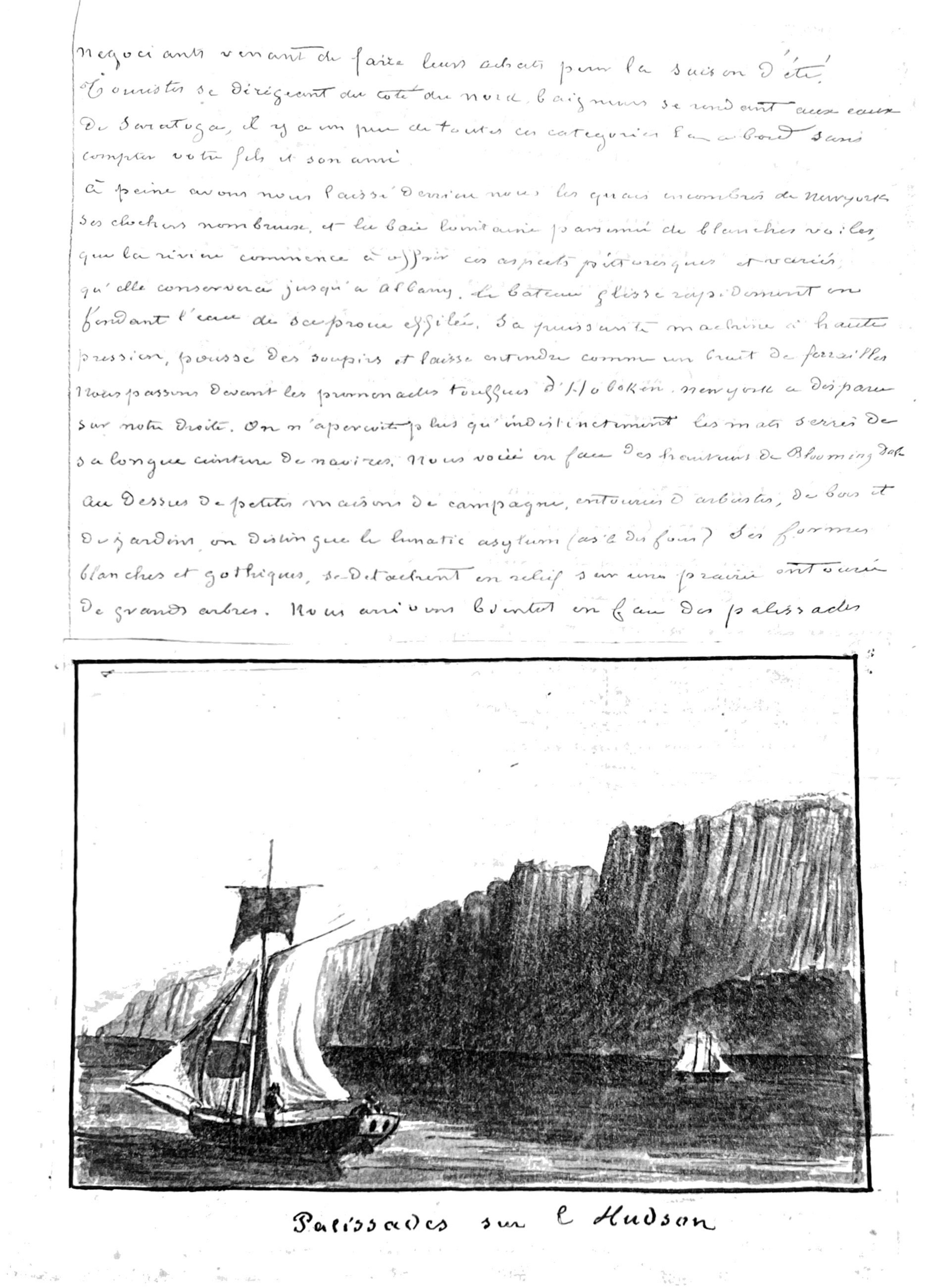
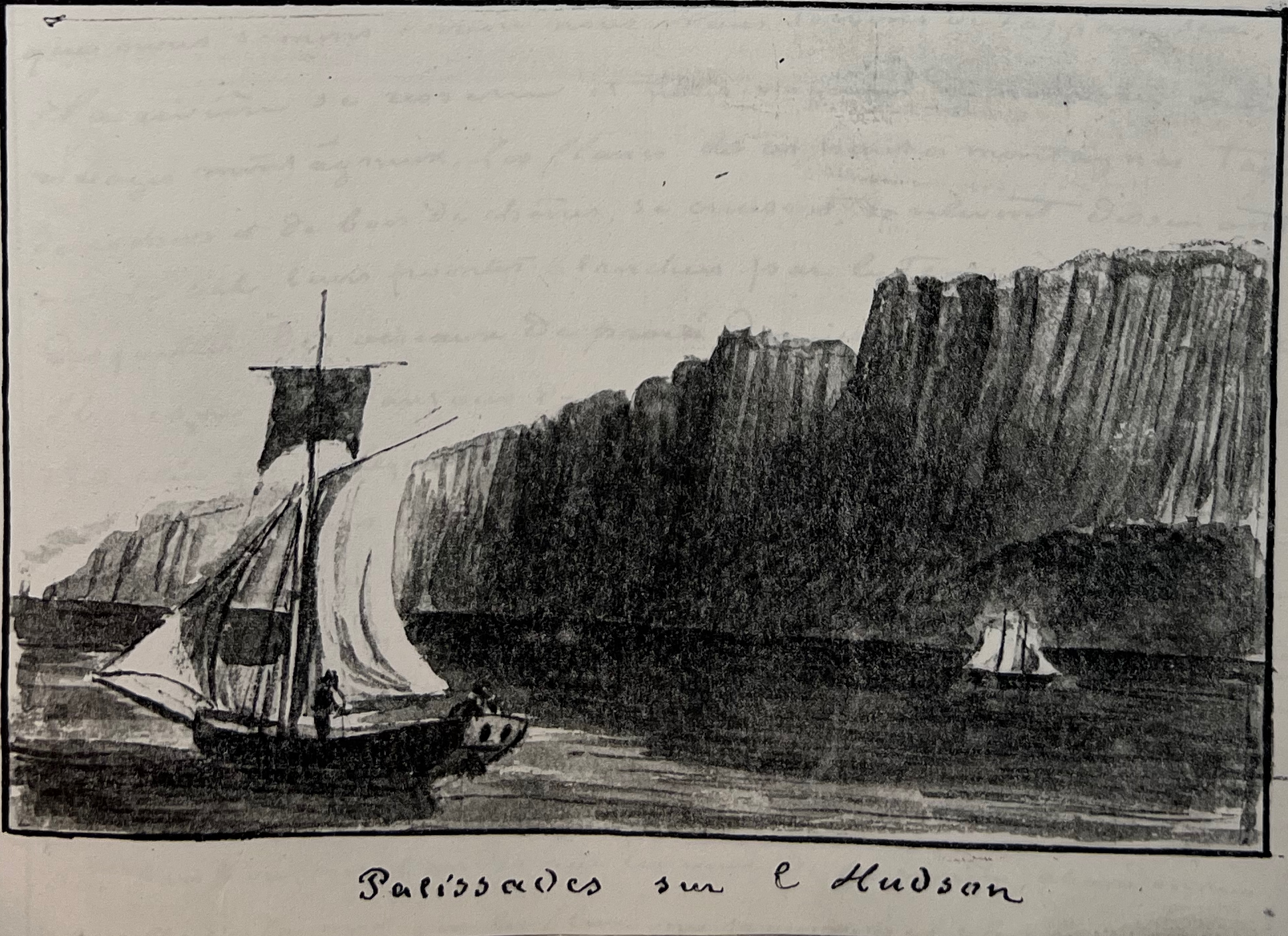
Hardly have we left behind us the crowded quays of New York its numerous steeples, and the distant bay strewn with white sails, when the river begins to offer those picturesque and varied aspects which it will keep as far as Albany. The boat glides swiftly, cleaving the water with her tapered bow. Her powerful high-pressure engine heaves sighs and lets out something like a clatter of scrap-iron. We pass before the leafy promenades of Hoboken. New York has disappeared on our right. One perceives no more than indistinctly the packed masts of her long belt of ships. Here we are opposite the heights of Bloomingdale. Above little country houses, surrounded by shrubs, by woods and by gardens one makes out the lunatic asylum (asile de fous). Its white and gothic forms stand out in relief against a meadow surrounded by tall trees. We soon come opposite the palisades It is an immense wall of sheer rocks, which border the river and rise, in certain places, to a height of 800 feet their grey heads, often beaten by storms, are outlined against the sky. Their bases, cluttered with fallen rock bathe deep in the dark green waters of the Hudson.
 (opens enlarged view)
The palisades have a length of about three miles. The opposite bank gracefully undulating, keeps its tall trees mingled with fine meadows. One barely glimpses a few country houses showing here and there their colonnaded porticoes. They are perhaps hotels.
We enter Tappan sea (la mer de Tappan). The name is justly deserved. It is a veritable little sea on the shores of which we faintly make out the village of Sing-Sing and the great state prison, which gives it a certain notoriety. A flotilla of sloops, (chaloupes à seul mât [single-masted launches]) wait sadly, mirroring themselves in the waves, with their sail hanging, for a breeze that does not come. We pass rapidly among them; they dance madly as they are reached by the waves we sow behind us. We come out of Tappan-sea.
The river narrows and we sail once more between two mountainous shores. The flanks of these high mountains carpeted with rocks and oak woods, hollow out, rise again tracing on the sky their peaks whitened by Time, around which birds of prey describe their slow spirals. There reigns then around us a charming solitude, barely troubled by a few fishermen's boats.
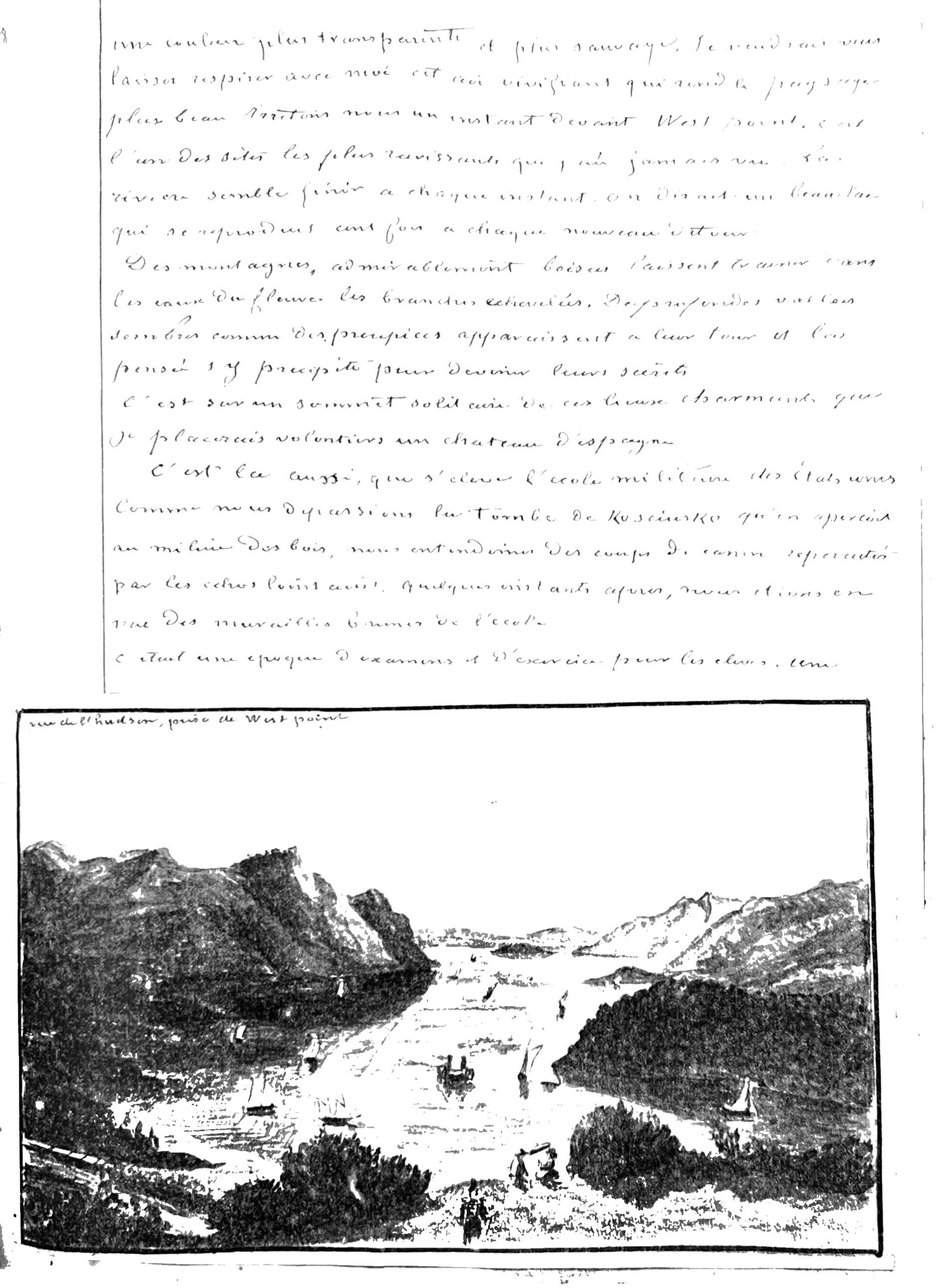
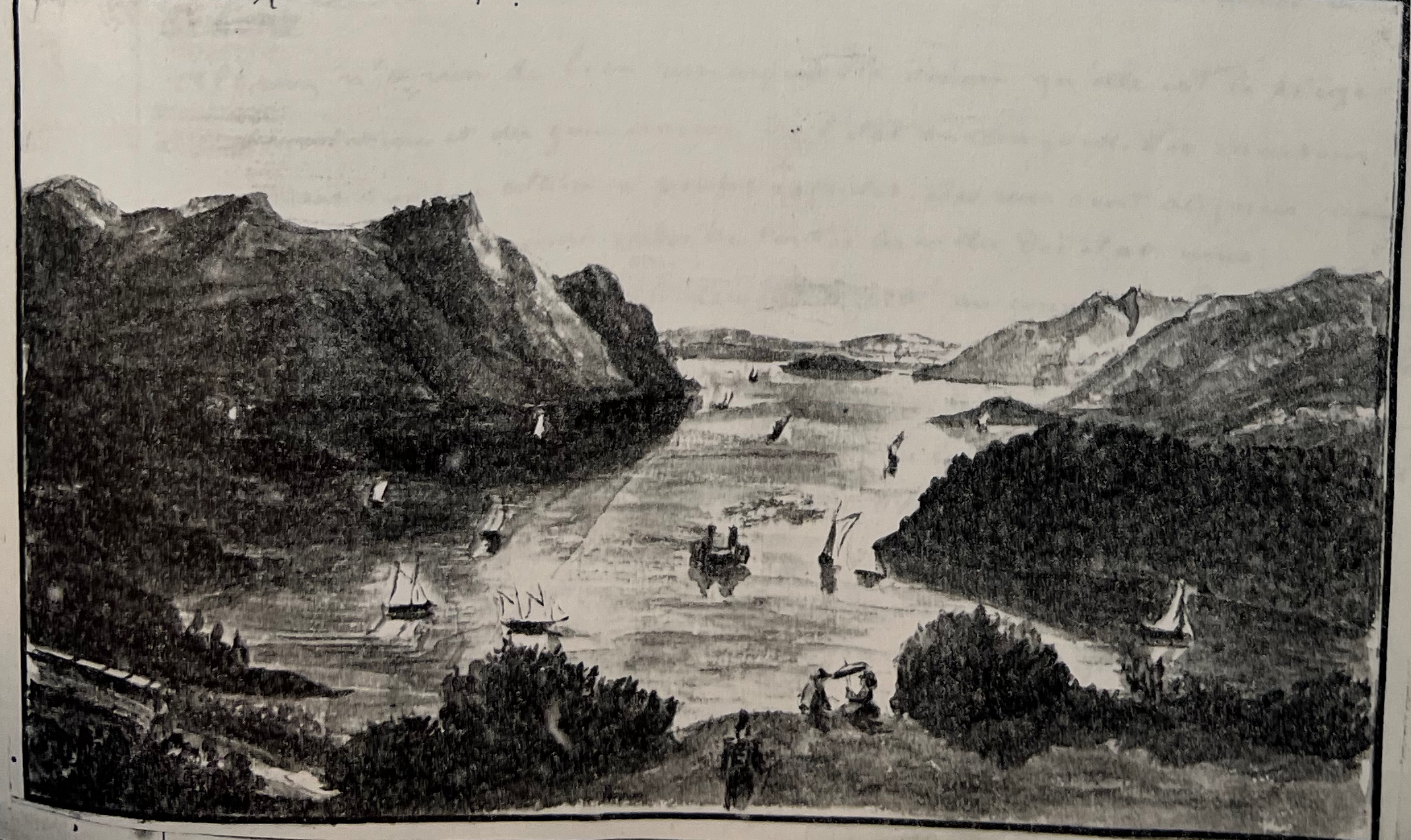
From time to time a village spreads its red brick houses on a cultivated slope it is there, 40 miles from New York, that one enters the High-Lands (pays de montagnes [mountain country]) the river seems to defy the traveller's admiration by multiplying its finest points of view. The mountains which surrounded it a moment ago, grow larger still. The vegetation takes on more austere forms. Rocks stand proudly in the midst of the thick woods, while the waters of the river, abandoned by those of the sea, which the tide pushes no farther, become a more transparent and more savage colour. I should like to let you breathe with me this invigorating air which makes the landscape more beautiful. Let us stop a moment before West point. It is one of the most ravishing sites I have ever seen. The river seems to end at every instant. One would say a fine lake which repeats itself a hundred times at each new bend.
Mountains, admirably wooded let the dishevelled branches trail in the waters of the river. Deep valleys dark as precipices appear in their turn and thought rushes into them to guess their secrets.
It is on a solitary summit of these charming places that I would gladly set a château d'espagne [castle in Spain].
It is there too that the military school of the United States rises. As we were passing the tomb of Kosciusko which one sees in the midst of the woods, we heard cannon shots thrown back by the distant echoes. A few moments later, we were in sight of the brown walls of the school.
 (opens enlarged view)
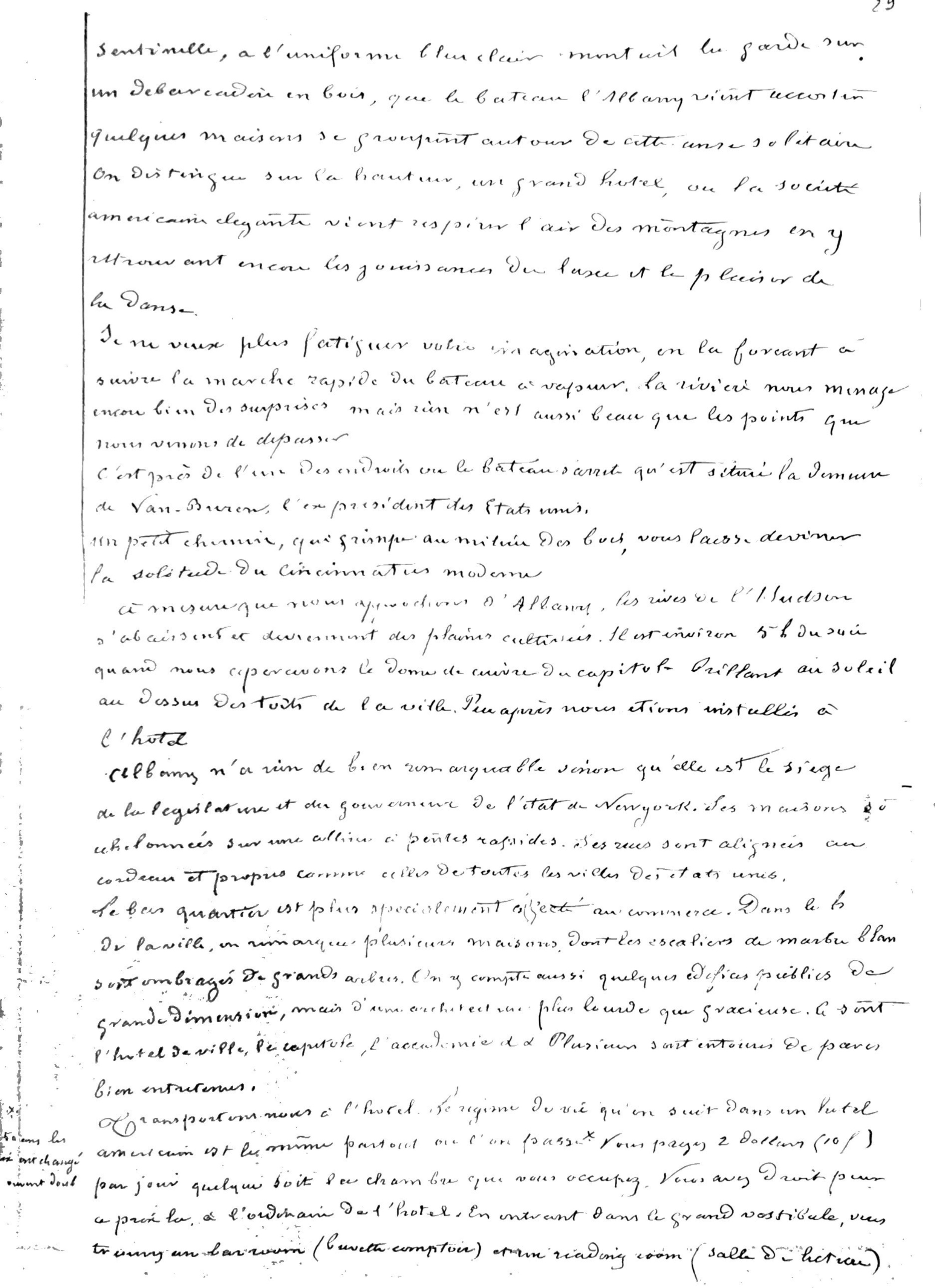
It was a season of examinations and drill for the pupils. A sentinel, in a light-blue uniform, was mounting guard on a wooden landing, which the boat the Albany came alongside a few houses are grouped about this solitary cove one makes out on the height a great hotel, where elegant American society comes to breathe the air of the mountains while still finding there the enjoyments of luxury and the pleasure of the Dance.
I will not tire your imagination any further, by forcing it to follow the rapid progress of the steamboat. The river holds still many surprises in store for us but nothing is as beautiful as the points we have just passed.
It is near one of the places where the boat stopped that the dwelling of Van Buren, the ex-president of the United States, is situated. A little path, which climbs up through the woods, lets you guess at the solitude of the modern Cincinnatus.
As we approach Albany, the banks of the Hudson fall away and become cultivated plains. It is about 5 h in the evening when we catch sight of the copper dome of the capitol shining in the sun above the roofs of the town. Soon after we were installed at the hotel.
Albany has nothing very remarkable about it except that it is the seat of the legislature and of the governor of the state of New York. Its houses are ranged in tiers on a hill with steep slopes. Its streets are laid out to the line and clean like those of all the towns of the United States.
The lower quarter is more especially given over to commerce. In the upper part of the town, one notices several houses whose white marble stairs are shaded by great trees. There are also to be counted a few public buildings of large dimensions, but of an architecture more heavy than graceful. These are the town hall, the capitol, the academy etc. Several are surrounded by well-kept parks.
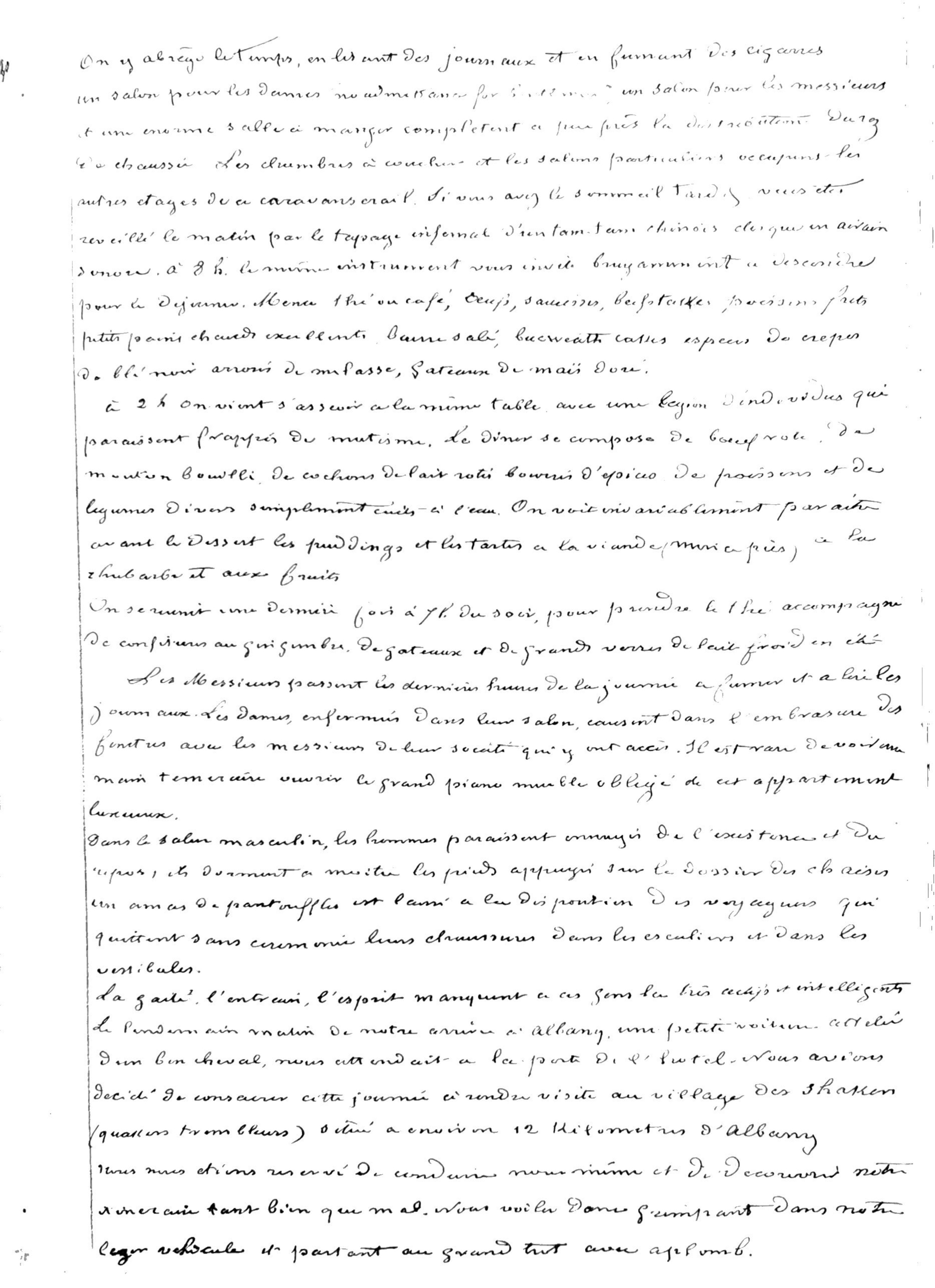
Let us transport ourselves to the hotel. The regime of life one follows in an American hotel is the same everywhere one goes. You pay 2 dollars (10 f) a day whatever the room you occupy. You are entitled, for that price, to the ordinary of the hotel. On entering the great vestibule, you find a bar-room (buvette comptoir [drinking counter]) and a reading room (salle de lecture) There one shortens the time, by reading newspapers and smoking cigars a parlor for the ladies (no admittance for gentlemen!) a parlor for the gentlemen and an enormous dining room complete more or less the arrangement of the ground floor. The bedrooms and the private parlors occupy the other floors of this caravanserai. If you are a late sleeper, you are woken in the morning by the infernal racket of a Chinese tam-tam a sonorous brass disc. At 8 h. the same instrument noisily invites you to come down for breakfast. Menu: tea or coffee, eggs, sausages, beefsteaks fried fish excellent hot rolls, salted butter, bucweath cakes a sort of buckwheat pancakes drenched in molasses, cakes of golden maize.
At 2 h one comes and sits at the same table with a legion of individuals who appear stricken with muteness. The dinner consists of roast beef, of boiled mutton of roast suckling pigs covered with spices of fish and of various vegetables simply boiled in water. One invariably sees appear before the dessert the puddings and the tarts of meat (mince pies) of rhubarb and of fruit.
One gathers a last time at 7 h in the evening, to take tea accompanied by ginger preserves, by cakes and by large glasses of cold milk in summer.
The Gentlemen pass the last hours of the day smoking and reading the newspapers. The ladies, shut up in their parlor, chat in the window recesses with the gentlemen of their society who have access there. It is rare to see a bold hand open the grand piano obligatory furniture of this luxurious apartment.
In the masculine parlor, the men appear bored with existence and with rest, they are half asleep with their feet propped on the backs of the chairs a heap of slippers is left at the disposal of travelers who shed their shoes without ceremony in the stairways and in the vestibules.
Gaiety, dash, wit are wanting in those people there, very active and intelligent. The morning after our arrival at Albany, a little carriage harnessed to a good horse was waiting for us at the door of the hotel. We had decided to devote that day to paying a visit to the village of the Shakers (quakers trembleurs [trembling quakers]) situated about 12 kilometers from Albany.
We had reserved to ourselves the driving of it ourselves and the finding out of our route as best we could. So here we are climbing into our light vehicle and setting off at a full trot with aplomb.
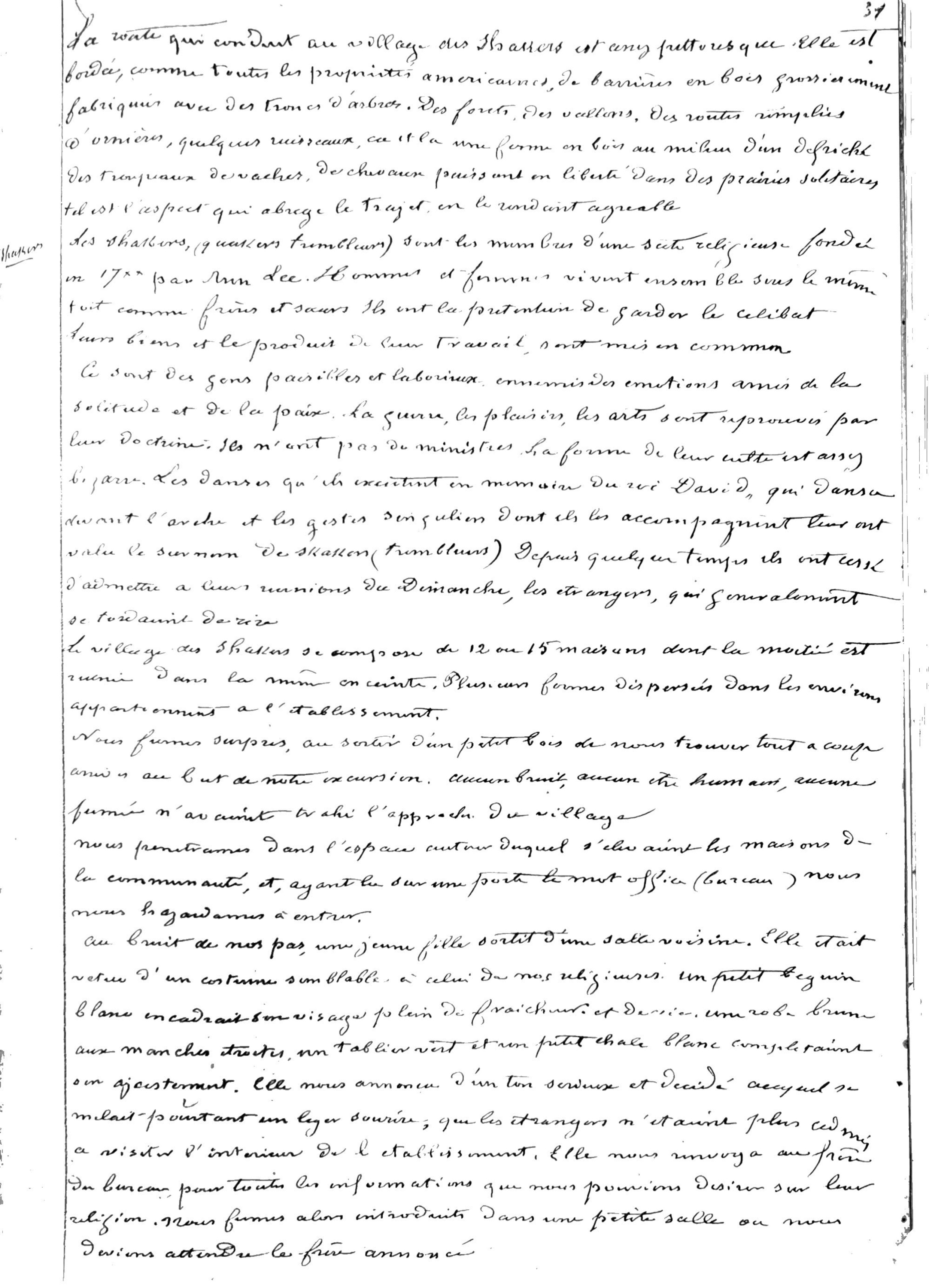
The road that leads to the village of the Shakers is as picturesque as it is bordered, like all American properties, with wooden fences roughly made out of tree trunks. Forests, small valleys, roads full of ruts, a few streams here and there a wooden farm in the middle of a clearing herds of cows, of horses grazing at liberty in solitary meadows such is the aspect that shortens the journey, by making it agreeable.
The Shakers, (quakers trembleurs [trembling quakers]) are the members of a religious sect founded in 17×× by Ann Lee. Men and women live together under the same roof as brothers and sisters. They have the pretension of keeping celibacy their goods and the product of their work, are put in common.
They are peaceable and laborious people enemies of emotions friends of solitude and of peace. War, pleasures the arts are reproved by their doctrine. They have no ministers. The form of their worship is rather bizarre. The dances they perform in memory of king David, who danced before the ark and the singular gestures with which they accompany them have earned them the nickname of Shakers (trembleurs [tremblers]). For some time now they have ceased to admit to their Sunday meetings, strangers, who generally were doubled up with laughter.
The village of the Shakers is composed of 12 or 15 houses of which half are gathered within the same enclosure. Several farms scattered in the neighborhood belong to the establishment.
We were surprised, on coming out of a little wood to find ourselves suddenly arrived at the goal of our excursion. No noise, no human being, no smoke had betrayed the approach of the village.
We made our way into the space around which rose the houses of the community, and, having read on a door the word office (bureau) we ventured to go in.
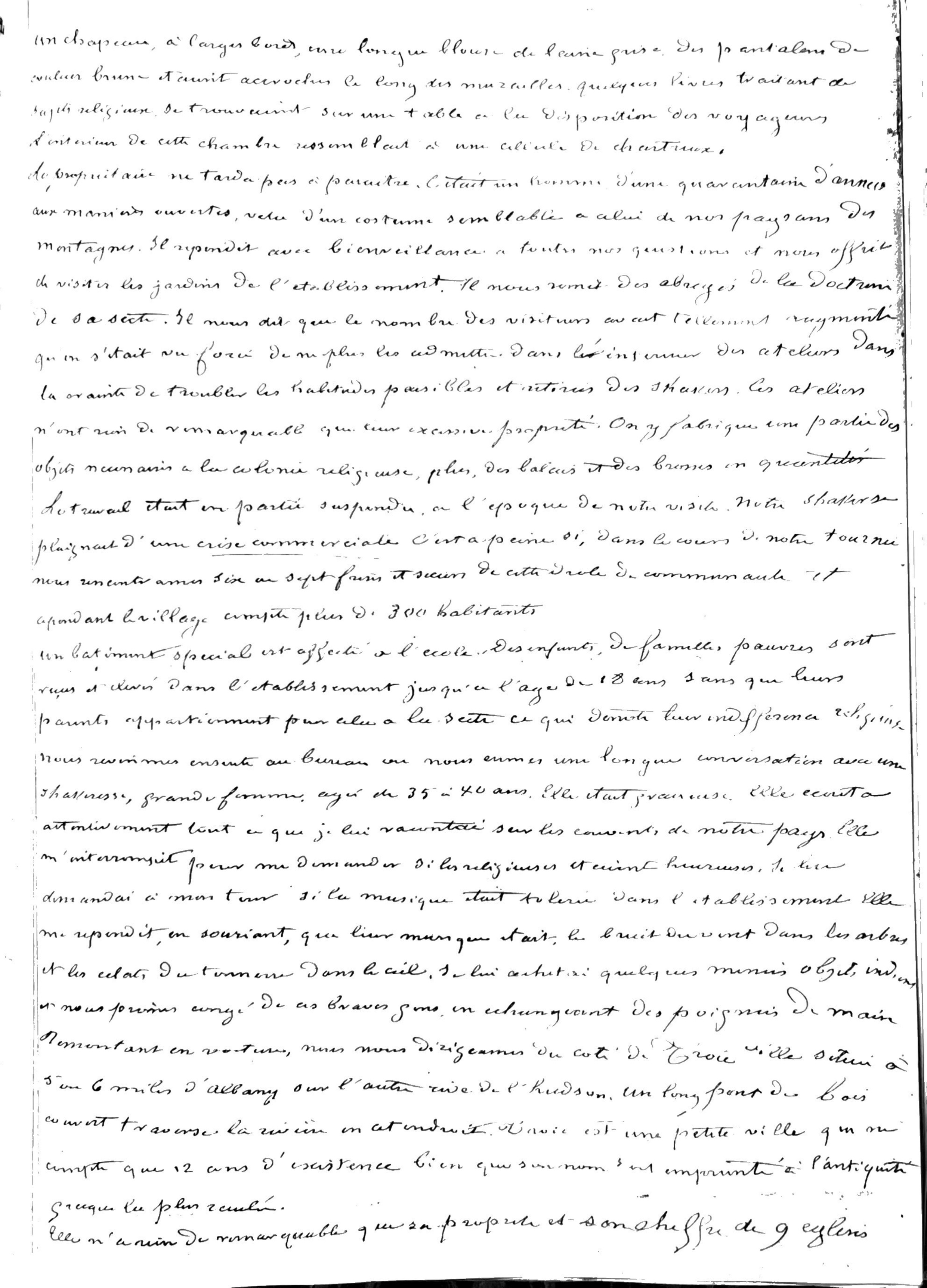
At the sound of our steps, a young girl came out of a neighboring room. She was dressed in a costume similar to that of our nuns. A little white béguin [close-fitting cap] framed her face full of freshness and of life. A brown dress with narrow sleeves, a green apron and a little white shawl completed her attire. She announced to us in a serious and decided tone with which there mingled nonetheless a slight smile, that strangers were no longer admitted to visit the interior of the establishment. She sent us to the brother of the office for all the information we might desire on their religion. We were then shown into a little room where we were to wait for the announced brother. A broad-brimmed hat, a long blouse of grey wool brown-colored trousers were hung along the walls. A few books treating of religious subjects were on a table at the disposal of travelers the interior of this room resembled a Carthusian's cell.
The proprietor did not delay in appearing. He was a man of some forty years with open manners, dressed in a costume similar to that of our mountain peasants. He answered all our questions with kindness and offered us a visit to the gardens of the establishment. He handed us abridgments of the doctrine of his sect. He told us that the number of visitors had so increased that they had found themselves forced no longer to admit them into the interior of the workshops for fear of disturbing the peaceable and retired habits of the Shakers. The workshops have nothing remarkable about them but their excessive cleanliness. There they manufacture a part of the objects necessary to the religious colony, plus, brooms and brushes in quantity. The work was in part suspended, at the time of our visit. Our Shaker complained of a commercial crisis we scarcely met, in the course of our round six or seven brothers and sisters of this odd community and yet the village counts more than 300 inhabitants.
A special building is given over to the school. Children of poor families are received and raised in the establishment until the age of 18 without their parents belonging for all that to the sect which denotes their religious indifference. We then came back to the office where we had a long conversation with a shakeress, a tall woman, aged 35 to 40. She was gracious. She listened attentively to all that I told her about the convents of our country. She interrupted me to ask me if the nuns were happy. I asked her in my turn if music was tolerated in the establishment. She answered me, smiling, that their music was: the noise of the wind in the trees and the bursts of thunder in the sky. I bought from her a few small manufactured objects and we took leave of these good people, exchanging handshakes.
Getting back into the carriage, we made our way toward Troie [Troy] a town situated 5 or 6 miles from Albany on the other bank of the Hudson. A long covered wooden bridge crosses the river at this spot. Troie is a little town which counts only 12 years of existence although its name is borrowed from the most remote Greek antiquity.
It has nothing remarkable about it but its cleanliness and its figure of 9 churches for a feeble population. One finds there again the commercial activity that reigns within the least of American towns. The road from Troie [Troy] to Albany is macadamized. It runs along a state arsenal and several country houses surrounded by meadows. We covered in 20 minutes the distance, which separated us from Albany. I say it to the praise of our horse, which in spite of the heat and of a long run, brought us back at a lively pace.