Voyage I · Three-mast Sailing Ship
Louis Philippe
Le Havre → New York · November 1841 · 35 Days
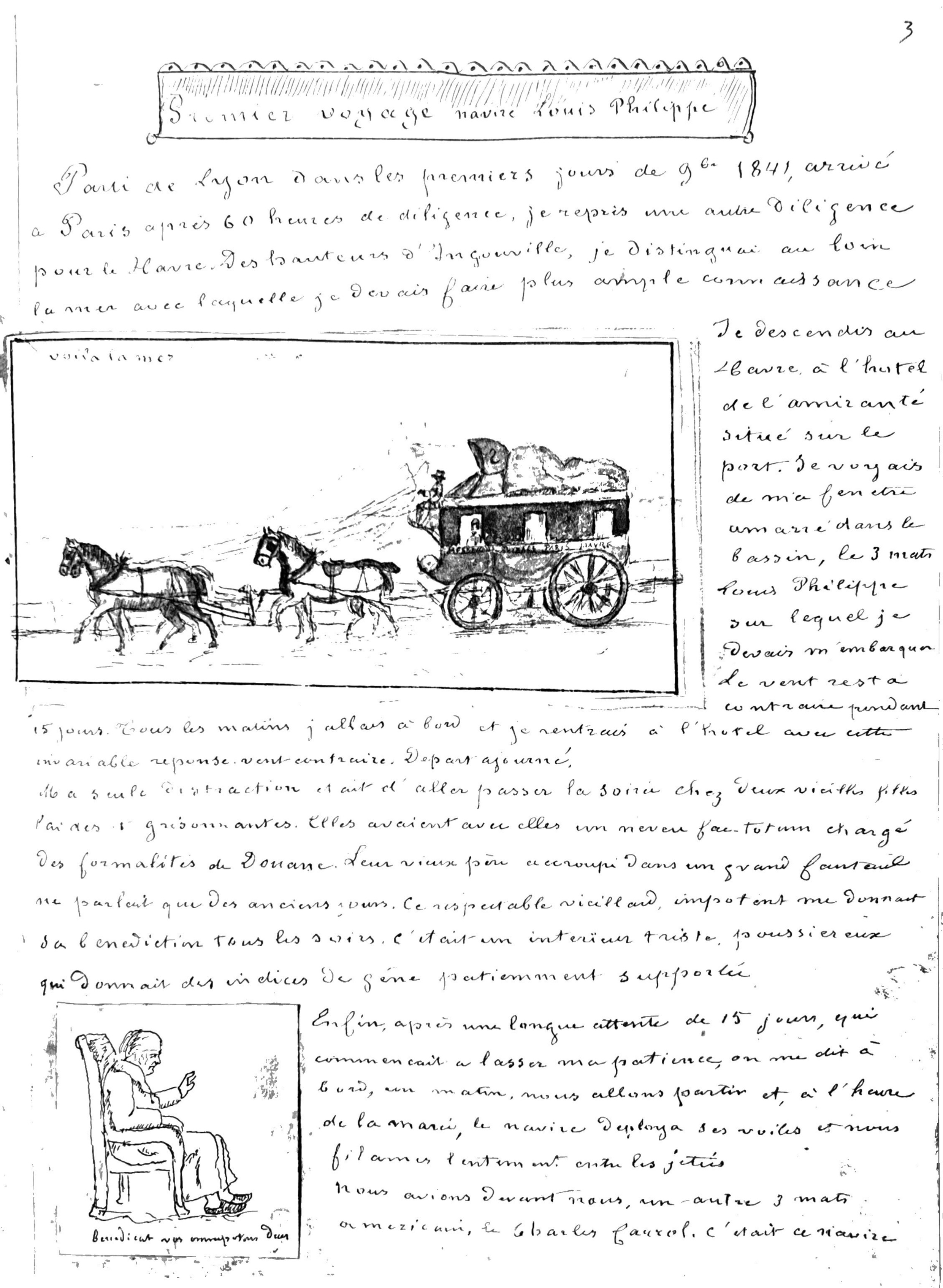
Leaving Lyon in the first days of November 1841, I arrived in Paris after 60 hours by diligence, then took another diligence for Le Havre. From the heights of Ingouville, I made out in the distance the sea, with which I was to become better acquainted.
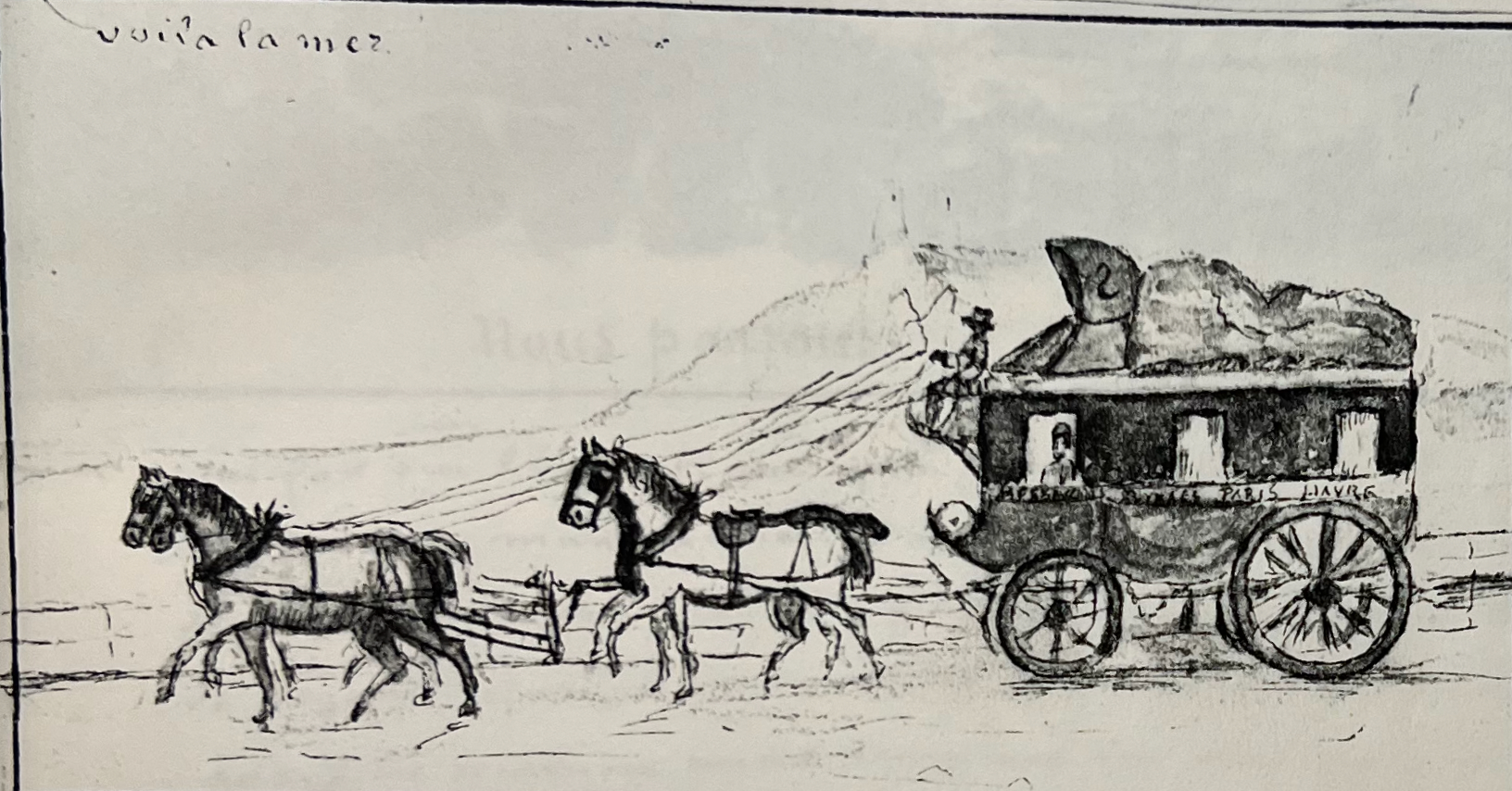 (opens enlarged view)
I put up at Le Havre at the hôtel de l'amirauté on the port. From my window I could see, moored in the basin, the three-master Louis Philippe, on which I was to embark; the wind stayed contrary for a fortnight. Every morning I went aboard, and returned to the hotel with the same invariable answer: contrary wind. Departure postponed.
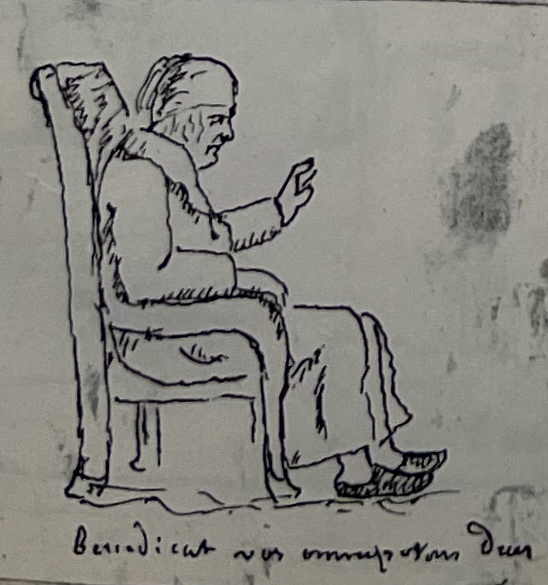
My only distraction was to go and pass the evening with two old maids, ugly and graying. They had with them a factotum nephew charged with the Customs formalities. Their old father, hunched in a great armchair, spoke of nothing but the old days. This respectable old man, an invalid, gave me his blessing every evening. It was a sad, dusty household that gave signs of straitened means patiently borne.
 (opens enlarged view)
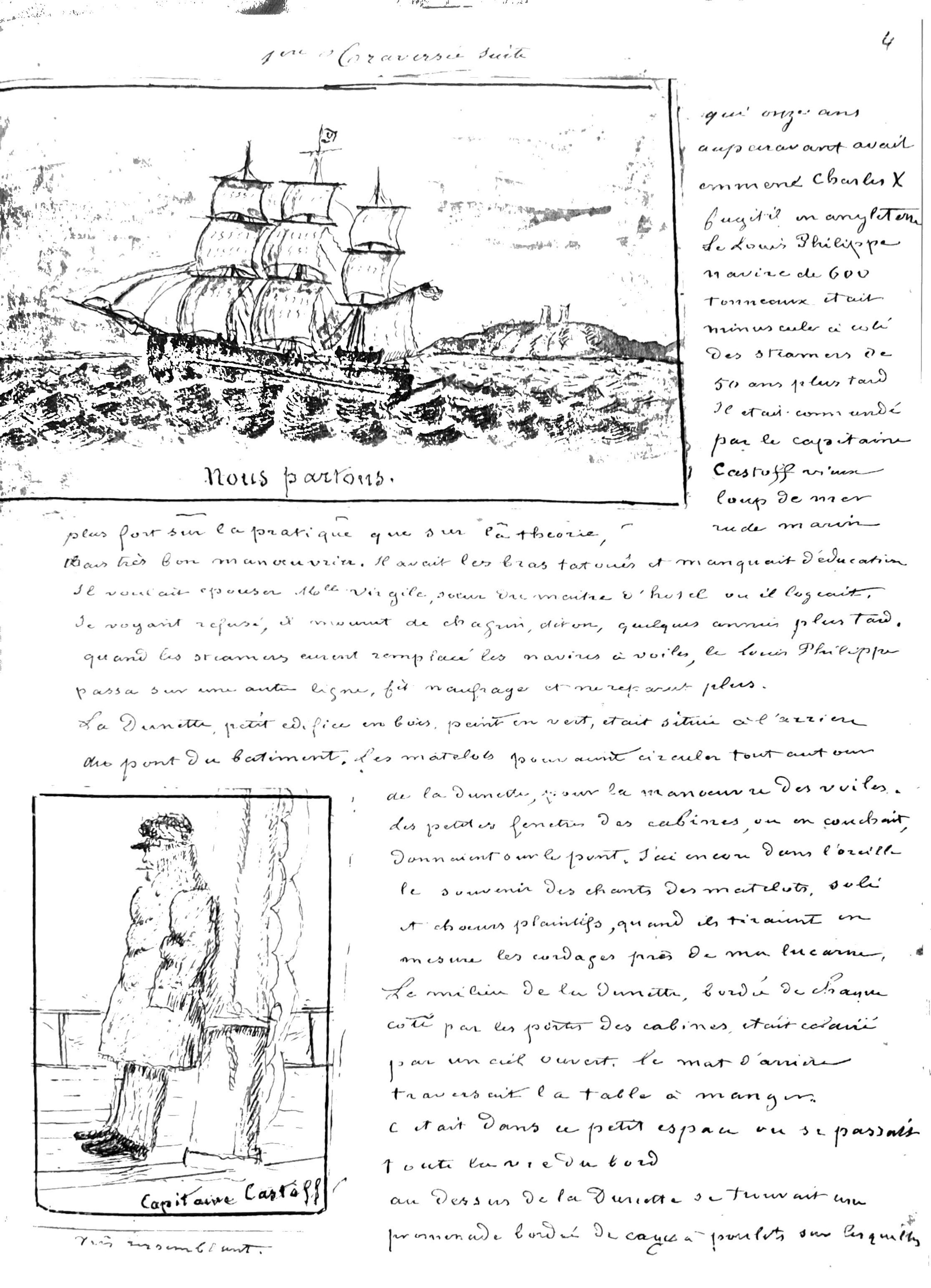
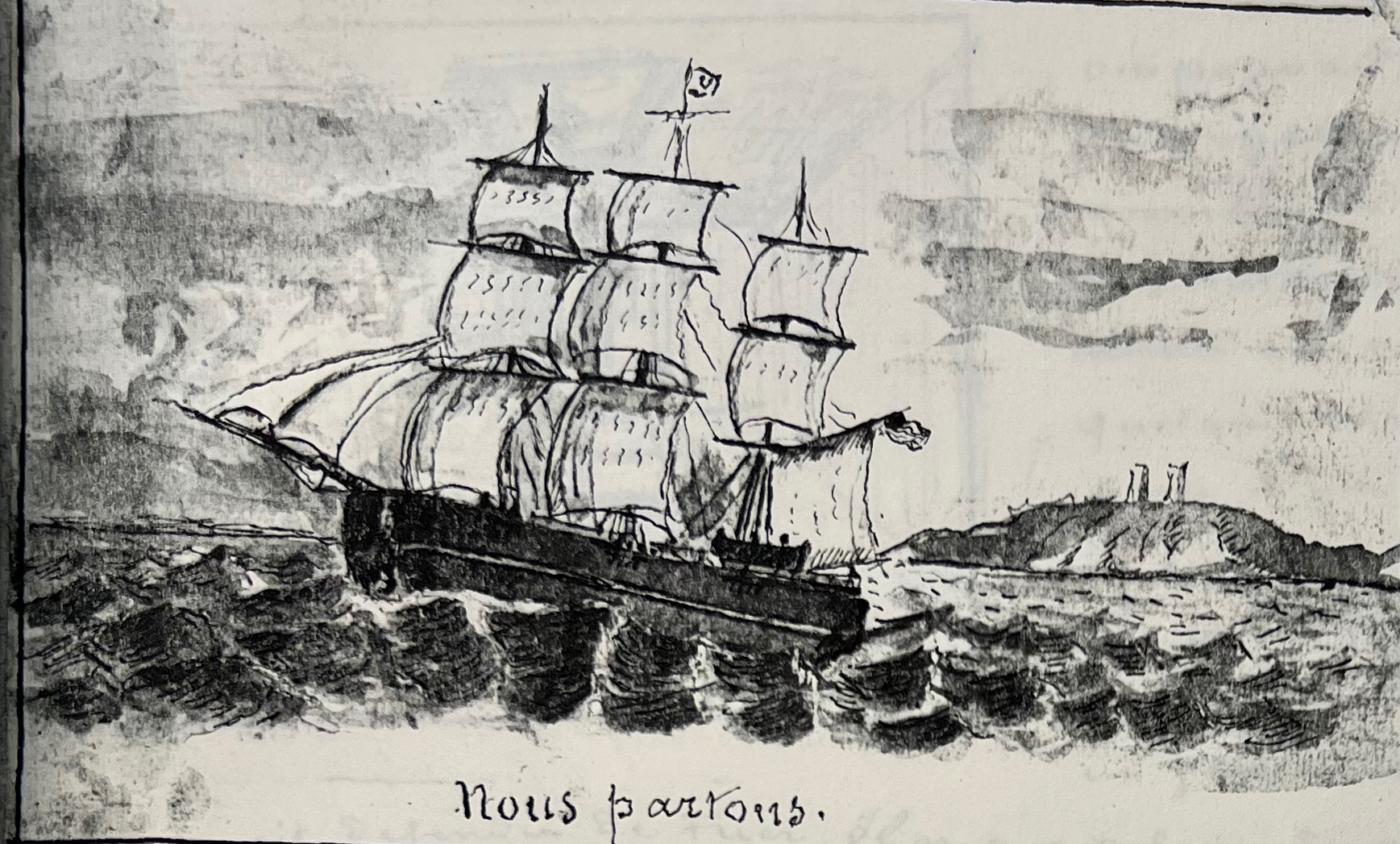
At last, after a long wait of a fortnight that was beginning to wear out my patience, I was told on board one morning: we are leaving — and at the hour of the tide, the ship spread her sails and we slipped slowly out between the jetties.
 (opens enlarged view)
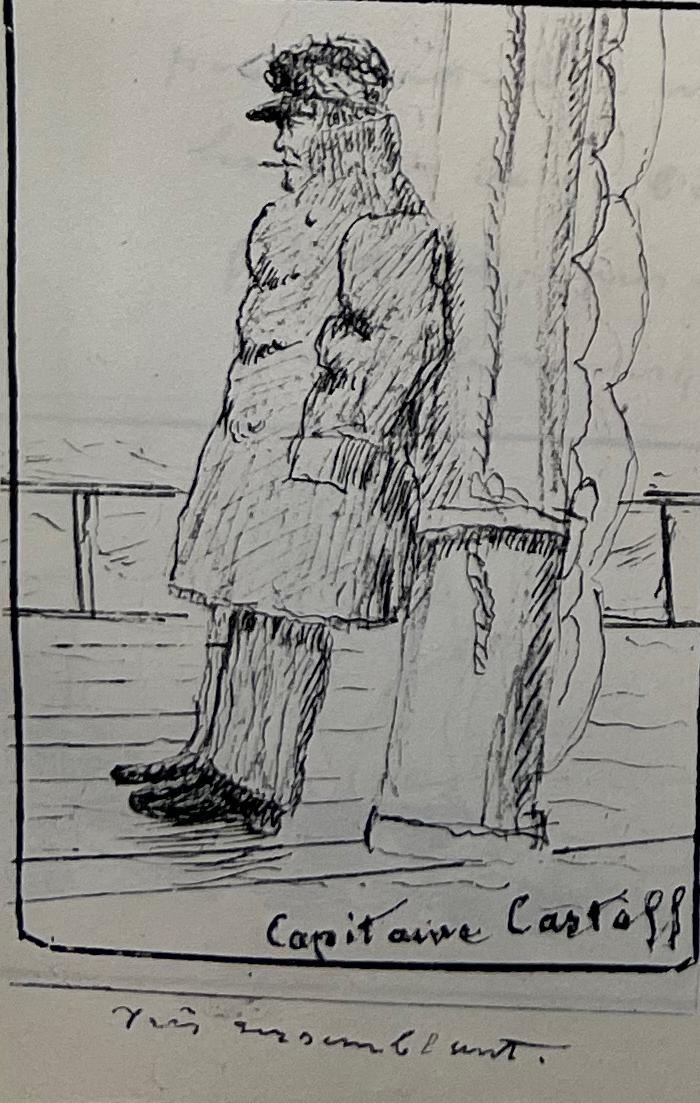
Ahead of us was another American three-master, the Charles Carrol. It was that ship which eleven years before had carried the fugitive Charles X to England. The Louis Philippe, a ship of 600 tonneaux [tons burthen], was minuscule beside the steamers of 50 years later. She was commanded by Captain Castoff, an old sea dog, a rough sailor, stronger on practice than on theory, but a very good handler of a ship. He had tattooed arms and lacked education. He wished to marry Mlle Virgile, sister of the keeper of the hotel where he lodged. Seeing himself refused, he died of grief, it is said, some years later. When the steamers had replaced the sailing ships, the Louis Philippe passed to another line, was wrecked, and was never seen again.
 (opens enlarged view)
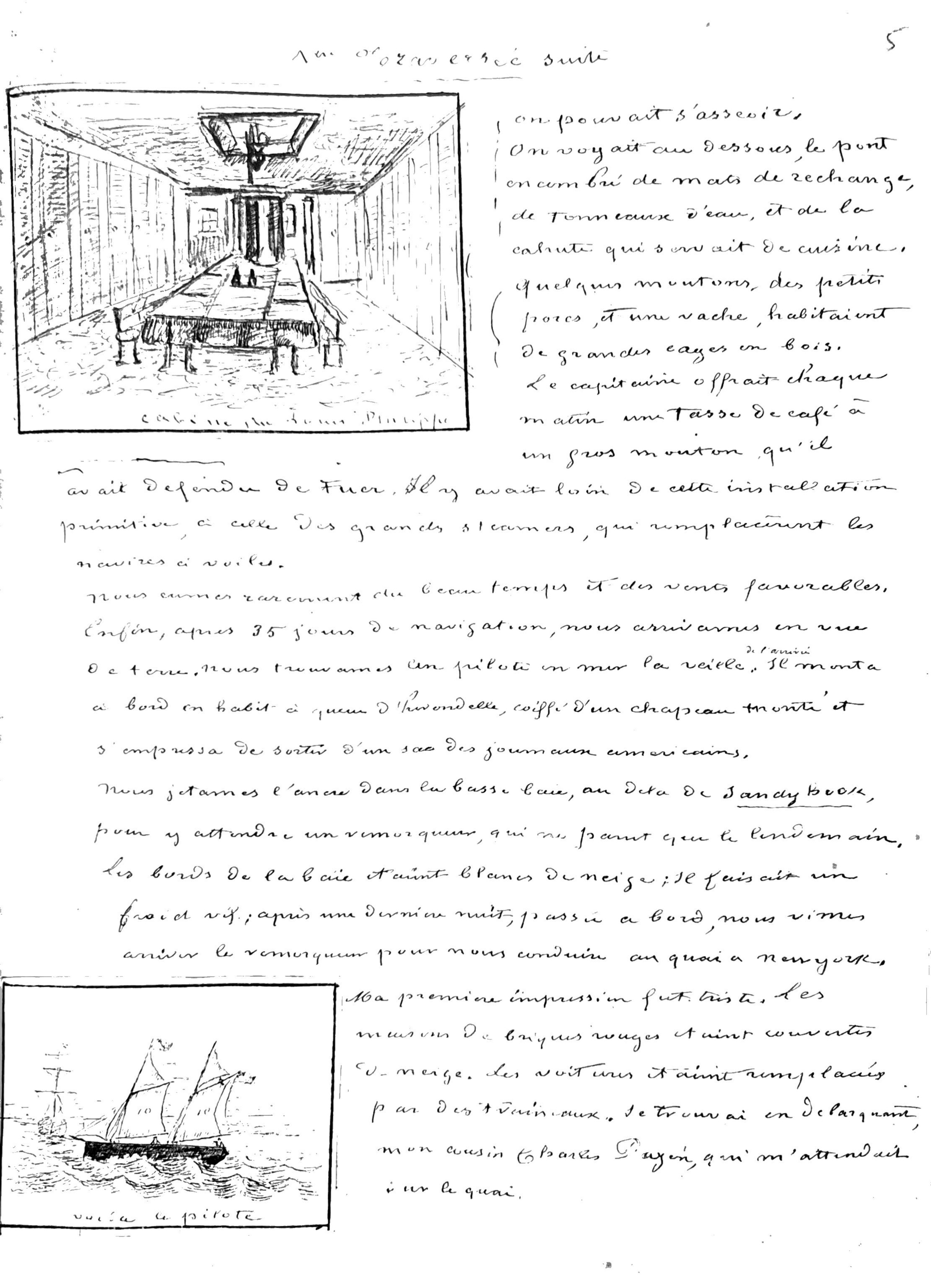
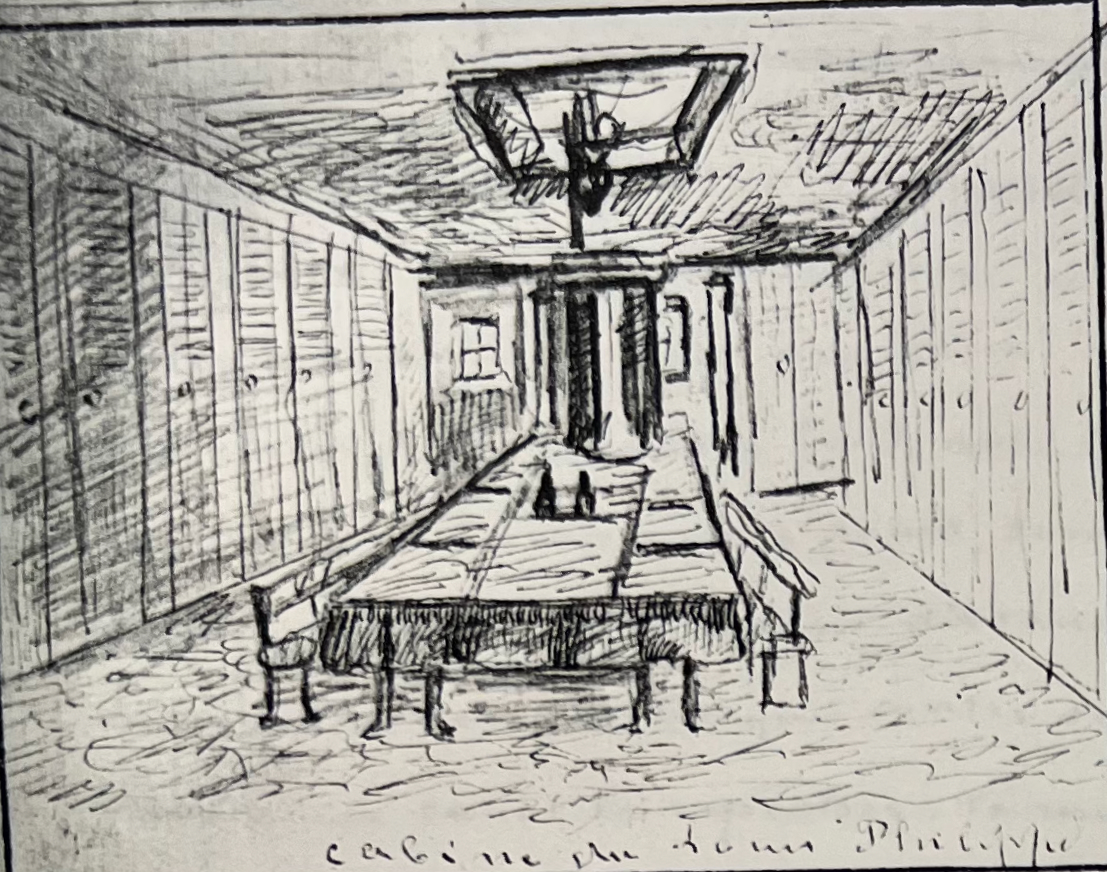
The dunette [after deckhouse] — a small wooden structure, painted green — stood at the after end of the ship's deck; the sailors could move all the way around it to work the sails. The little windows of the cabins, where we slept, gave onto the deck. I still carry in my ear the memory of the sailors' chants — plaintive solos and choruses — as they hauled the ropes in time close by my skylight. The middle of the dunette, bordered on each side by the cabin doors, was lit by an open skylight. The after-mast passed through the dining table. It was in this little space that the whole life on board went on.
 (opens enlarged view)
Above the dunette was a promenade bordered with chicken-coops on which one could sit. Below, one saw the deck cluttered with spare masts, water casks, and the hut that served as the kitchen; a few sheep, some piglets, and a cow lived in big wooden cages. Every morning the captain offered a cup of coffee to a fat sheep he had forbidden to be slaughtered. It was a far cry from this primitive arrangement to that of the great steamers which replaced the sailing ships.
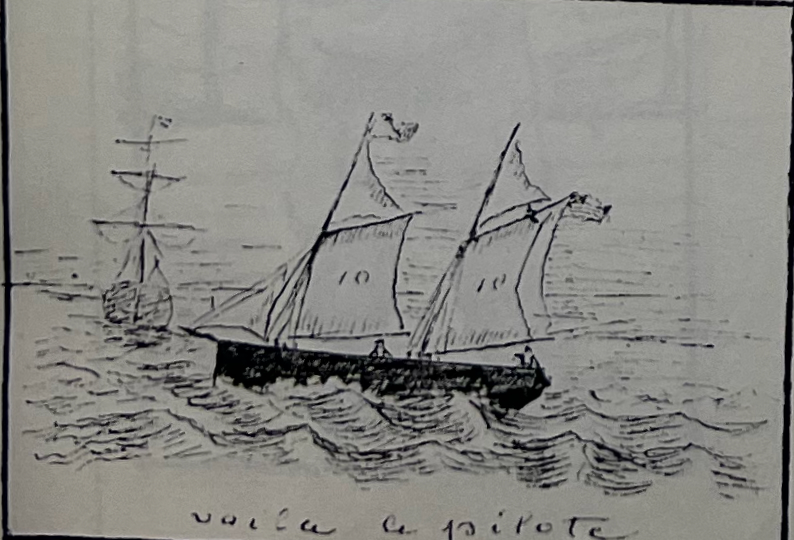
We rarely had fine weather or favorable winds. At last, after 35 days of sailing, we came in sight of land. We found a pilot at sea the day before our arrival. He came aboard in a swallow-tail coat, wearing a blocked hat, and hastened to pull American newspapers out of a sack.
We dropped anchor in the lower bay, beyond Sandy Hook, to wait there for a tug, which did not appear until the next day. The shores of the bay were white with snow; the cold was sharp; after one last night spent on board, we saw the tug arrive to bring us to the quay at New York.
 (opens enlarged view)
My first impression was a sad one. The red brick houses were covered with snow. Carriages had been replaced by sleighs. On landing I found my cousin Charles Payen (?), who was waiting for me on the quay.