Voyages X–XI · American Steamers · Capt. Luce · 1851–1852
Franklin · Arctic
New York → Le Havre · Liverpool → New York · 1851–1852
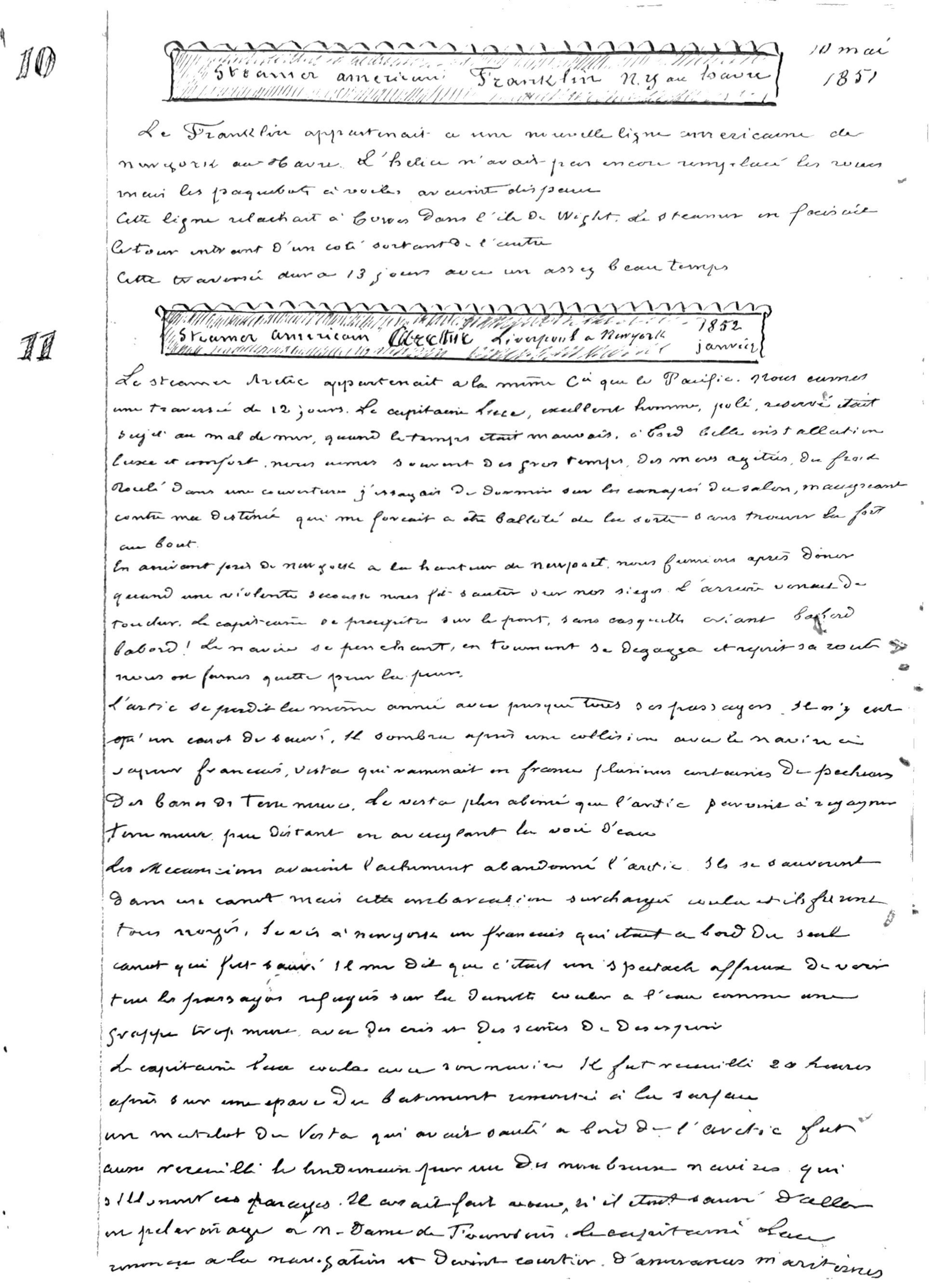
X — Franklin, New York to Le Havre, 10 May 1851. The Franklin belonged to a new American line from New York to Le Havre. The screw had not yet replaced the paddle-wheels, but the sailing packets had disappeared. This line called at Cowes on the Isle of Wight, the steamer went round it entering on one side going out the other. This crossing lasted 13 days, in fairly fine weather.
XI — Arctic, Capt. Luce, Liverpool to New York, January 1852. The steamer Arctic belonged to the same company as the Pacific. We had a 12-day crossing. Captain Luce — an excellent man, polite, reserved — was himself subject to seasickness when the weather was bad. Aboard, fine fittings, luxury and comfort. We often had heavy weather, rough seas, cold. Rolled in a blanket, I tried to sleep on the saloon sofas, grumbling against my destiny which forced me to be tossed about in this way without finding fortune at the end of it.
Arriving near New York, off Newport, we were smoking after dinner when a violent shock made us jump on our seats. The stern had touched. The captain rushed on deck, capless, shouting port port! The ship, heeling as she turned, worked herself free and resumed her course; we got off with a fright.
The Arctic was lost that same year with nearly all her passengers. There was only one boat saved. She went down after a collision with the French steam vessel Vesta, which was carrying several hundred fishermen home to France from the Newfoundland banks. The Vesta, more damaged than the Arctic, managed to regain Newfoundland — not far off — by stopping her leak.
The engineers had abandoned the Arctic like cowards. They fled in a boat, but the overloaded craft sank and they were all drowned. I saw in New York a Frenchman who was aboard the only boat that was saved. He told me it was a frightful spectacle to see all the passengers, huddled on the dunette, go down into the water like an over-ripe grape cluster, with cries and scenes of despair.
Captain Luce sank with his ship. He was picked up 24 hours later on a piece of the vessel's wreckage that had floated back to the surface.
A sailor of the Vesta who had leapt aboard the Arctic was likewise picked up the next day by one of the many ships that ply those waters. He had made a vow, if he were saved, to go on pilgrimage to N-Dame de Fourvière. Captain Luce gave up the sea and became a marine-insurance broker.