Voyage III · English Steamer · Cunard Line
Cambria
Liverpool → Boston via Halifax · January 1845 · 23 Days
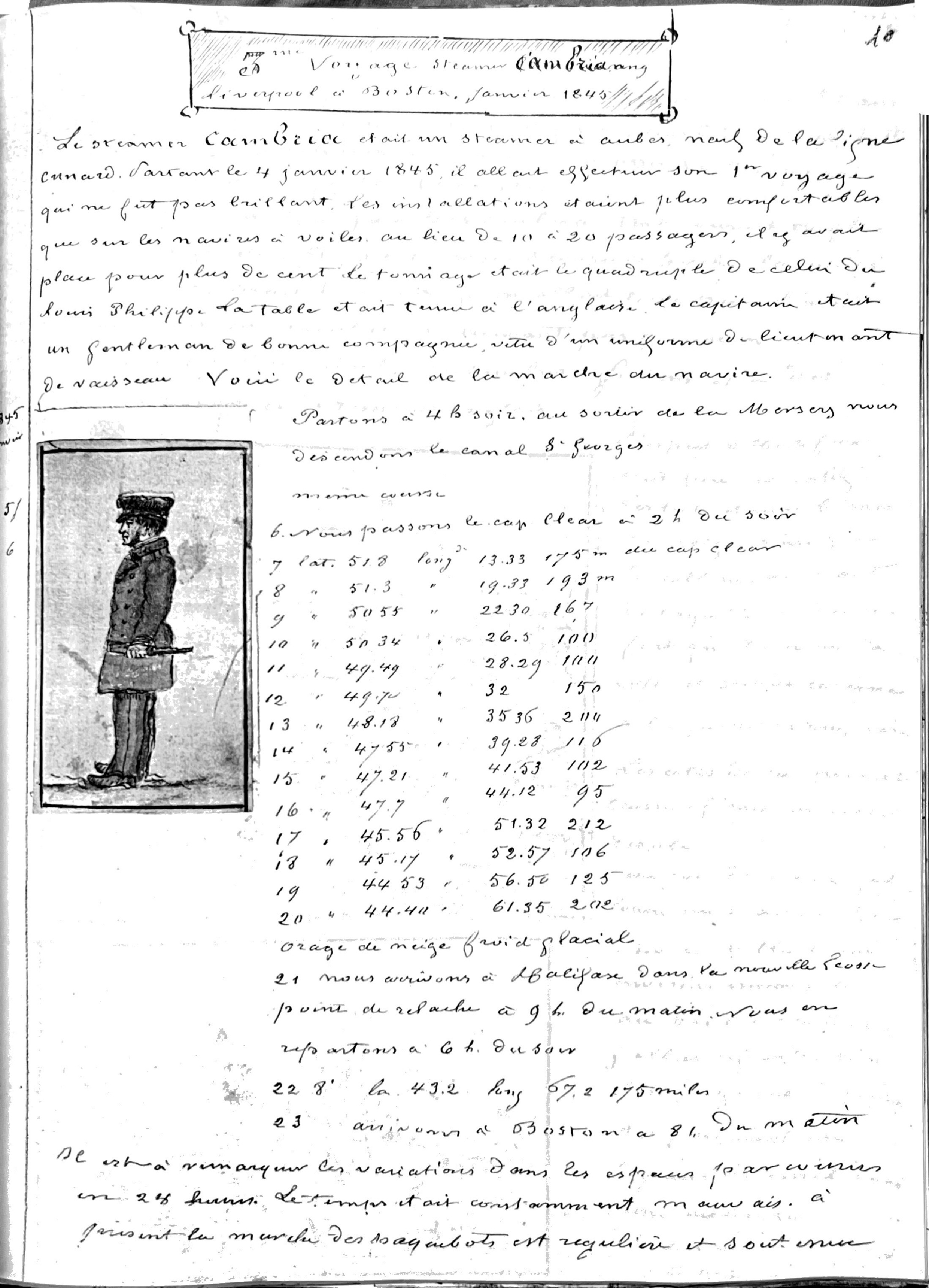
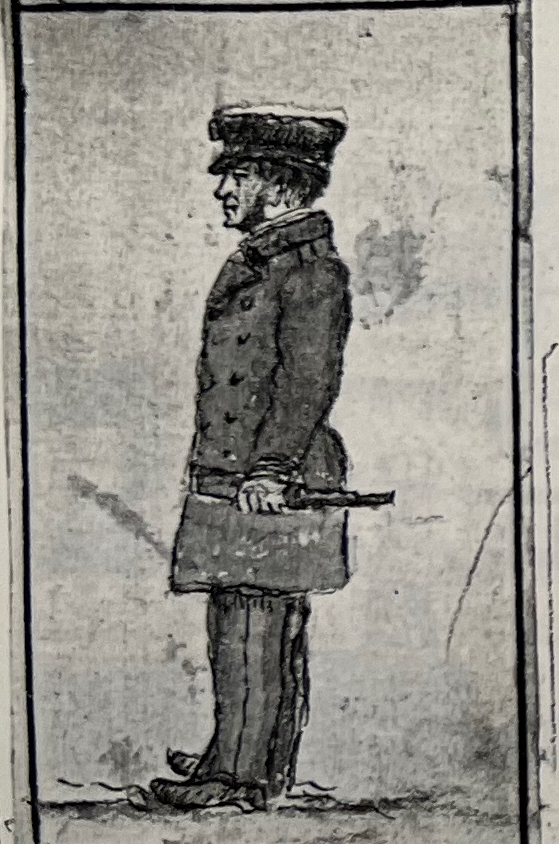
The steamer Cambria was a paddle steamer, new, of the Cunard line. Departing 4 January 1845, she was to make her 1st voyage — which was not a brilliant one. The accommodations were more comfortable than on the sailing ships. Instead of 10 to 20 passengers there was room for more than a hundred; the tonnage was four times that of the Louis Philippe. The table was kept in the English style. The captain was a gentleman of good company, dressed in the uniform of a navy lieutenant. Here is the detail of the ship's run.
 (opens enlarged view)
| Date | Conditions & Position |
|---|---|
| 4 Jan | We depart at 4 h in the evening. On leaving the Mersey we run down the canal St Georges [St George's Channel]. |
| 5 | Same course. |
| 6 | We pass cap Clear [Cape Clear] at 2 h in the evening. |
| 7 | lat. 51.8, long 13.33 — 175 m from cap Clear. |
| 8 | lat 51.3, long 19.33 — 193 m. |
| 9 | lat 50.58 (?), long 22.30 — 167 (?). |
| 10 | lat 50.34, long 26.3 (?) — 100. |
| 11 | lat 49.49, long 28.29 — 100. |
| 12 | lat 49.70 (?), long 32 — 150. |
| 13 | lat 48.18, long 35.36 (?) — 244. |
| 14 | lat 47.55, long 39.28 — 116. |
| 15 | lat 47.21, long 41.43 (?) — 102. |
| 16 | lat 47.7, long 44.12 — 95. |
| 17 | lat 45.56, long 51.32 — 212. |
| 18 | lat 45.17, long 52.57 — 106. |
| 19 | lat 44.53, long 56.52 (?) — 125. |
| 20 | lat 44.40 (?), long 61.35 — 202. Snowstorm, glacial cold. |
| 21 | We arrive at Halifax in Nova Scotia, port of call, at 9 h in the morning. We leave again at 6 h in the evening. |
| 22 | la 43.2, long 67.2 — 175 miles. |
| 23 Jan | Arrive at Boston at 8 h in the morning. |
It is worth remarking the variations in the distances covered in 24 hours. The weather was constantly bad. Nowadays the run of the packets is regular and sustained and gives an average of 30 miles an hour. Fifty years ago one dared not run at full steam when the weather was bad; the engines were not strong enough to fight against heavy storms.
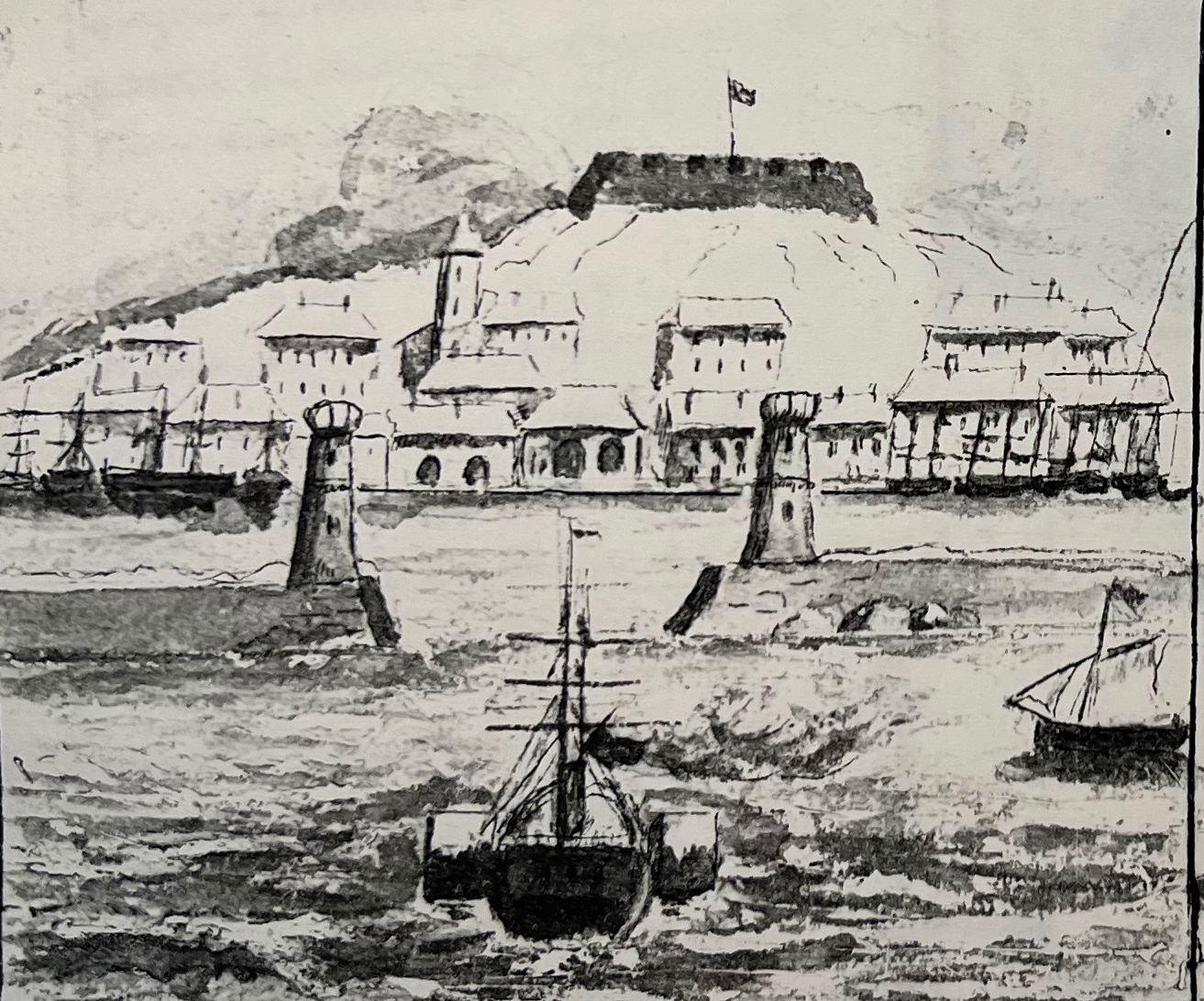
On arriving at Halifax the Cambria was covered in ice and frozen snow. The frozen snow covering the cannon that was to be fired for the arrival had to be broken off with axes. Rolled up in a blanket, unable to walk the deck, I was reduced to gloomy reflections and to readings of causeries (?) [light literary columns] of English novels.
 (opens enlarged view)
The look of Halifax was not a cheering one. The roofs were white with snow, as was the hill at whose summit rises a fort that commands the town and serves as barracks for the English garrison.
The coasts of Nova Scotia present a desolate aspect.
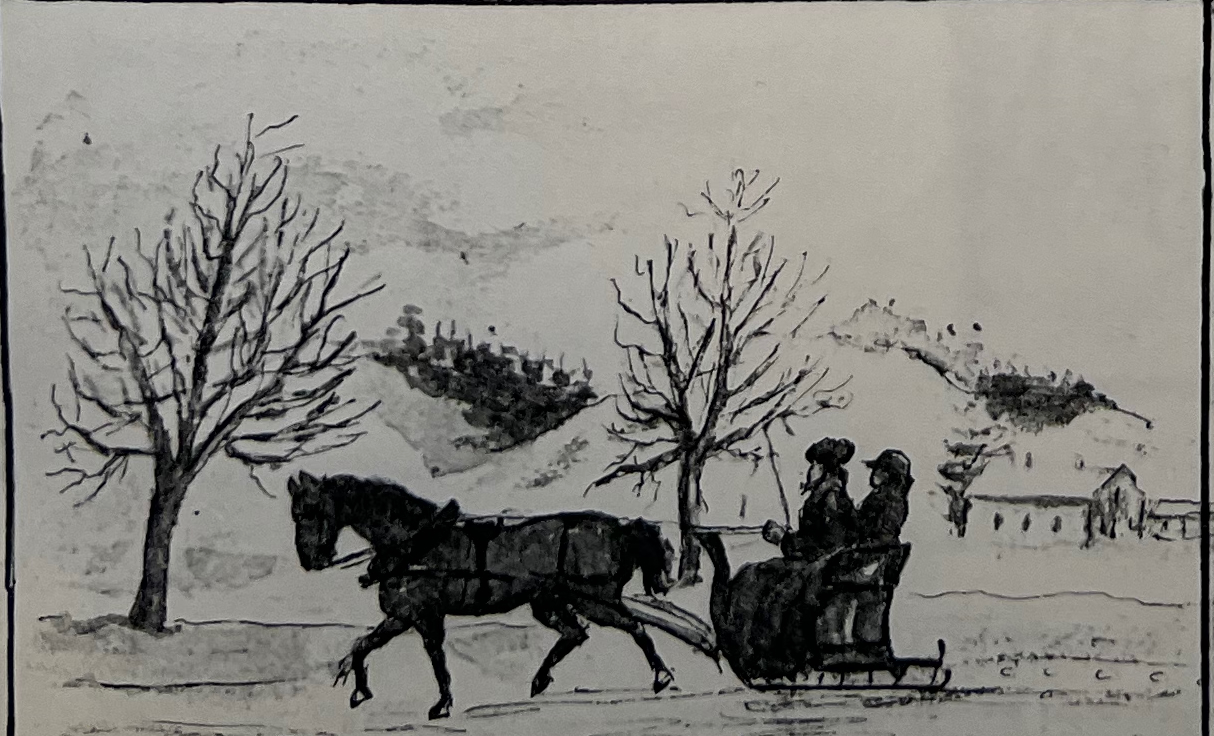
Once ashore I hired a sleigh to see the town and its immediate surroundings; after an hour I went to rejoin my traveling companions, who were making an infernal racket in an inn.
 (opens enlarged view)
The next day we were at Boston.