Chapter IV
Geneva · Rochester · Stage · Buffalo · Indians
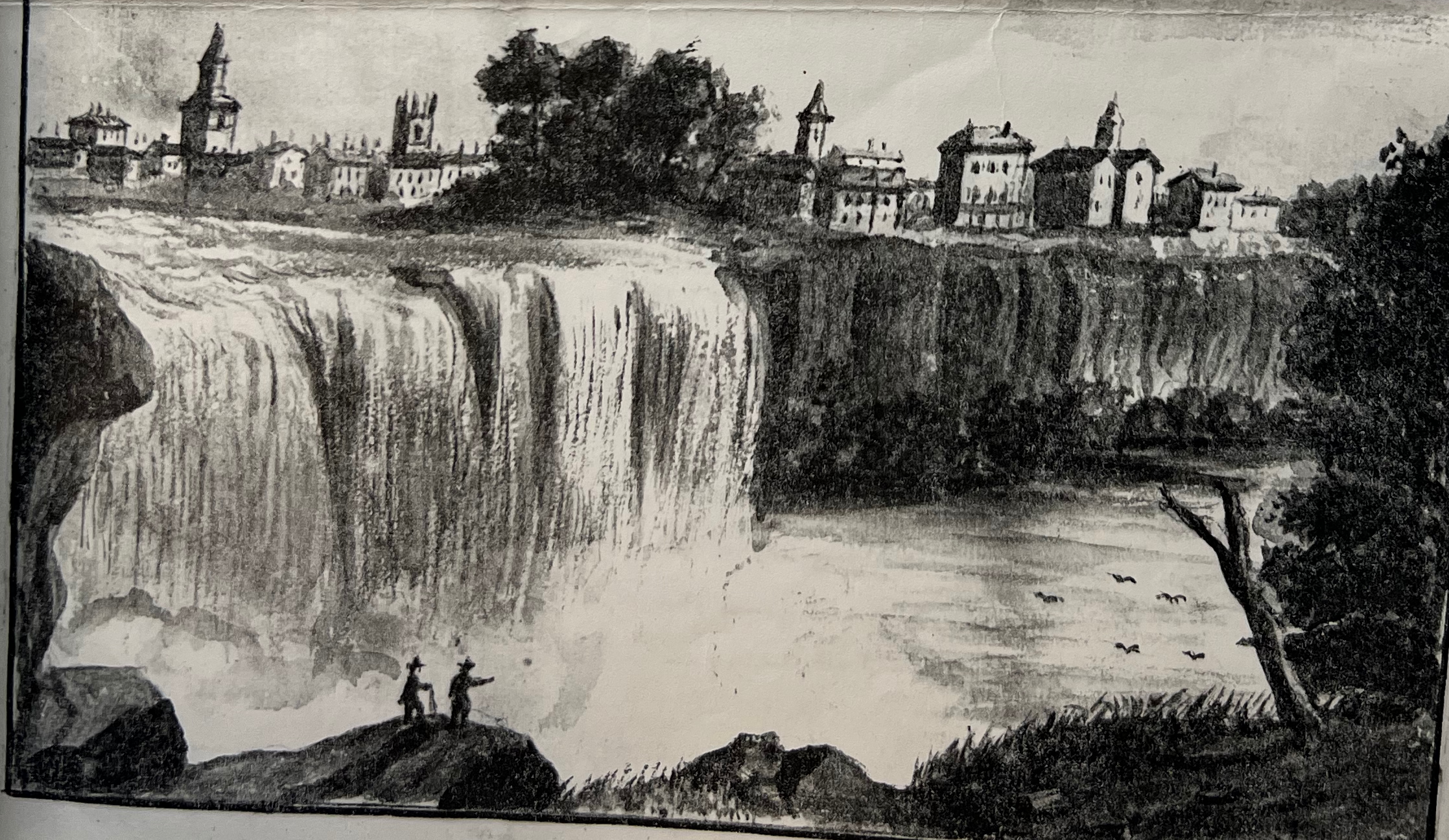
The journey from Auburn to Geneva takes about 4 hours by rail. One sees in passing Lake Seneca, crossed at one of its ends by a long wooden bridge. We arrived at Geneva at dinner time. It is a little town that admires itself in a beautiful lake, it is to this situation that it owes its name. We dined with Americans of the west, who showed us some politeness in our quality as foreigners. All these gentlemen, carefully shaved and dressed in black, did not have manners on a par with their Toilettes [dress]. My gaze rested with joy on the dining room's wallpaper — a rare thing at that period in America. It showed views of the railway from Lyon to Saint-Étienne. Before me I had the pont de la Mulatière, the maison de de la Perrière, and a railway train on the bridge, running toward Vernaison.
 (opens enlarged view)
Geneva has nothing agreeable about it but its position and its lake, whose wooded shores stretch into the distance; so, after a two-hour walk, we went back to the hotel. Unable to leave before ten in the evening, I proposed to my traveling companion a boat outing on the lake. I had noticed that morning a small boat moored near the hotel. Thanks to the hotel-keeper's good offices we obtained the use of this skiff, more or less the only one in the village. The rest of the day was spent rowing, breathing the lake's invigorating air and skirting its shores as they faded into the evening shadow.
While we were waiting for the train that was to carry us off, we were accosted by the owner of a hotel close by. He was an Englishman who had lived in France for 15 years. He had been a tulle manufacturer at Calais, knew Lyon and several Lyonnais merchants. He told us he was delighted to hear our language spoken, and that France was his second homeland. The train was signaled. He left us to oversee the preparations necessary for receiving the travelers — which consist of setting out on a buffet everything that composes an American supper. The travelers arrive, hurl themselves like a waterspout into the room, swallow, pay, and climb back into the cars.
At the stroke of the bell, two young girls took their places behind the buffet to serve tea — something less common in America than in England. In America the women are almost Goddesses whose privileges are without bounds. They understood French and smiled as they listened to our conversation.
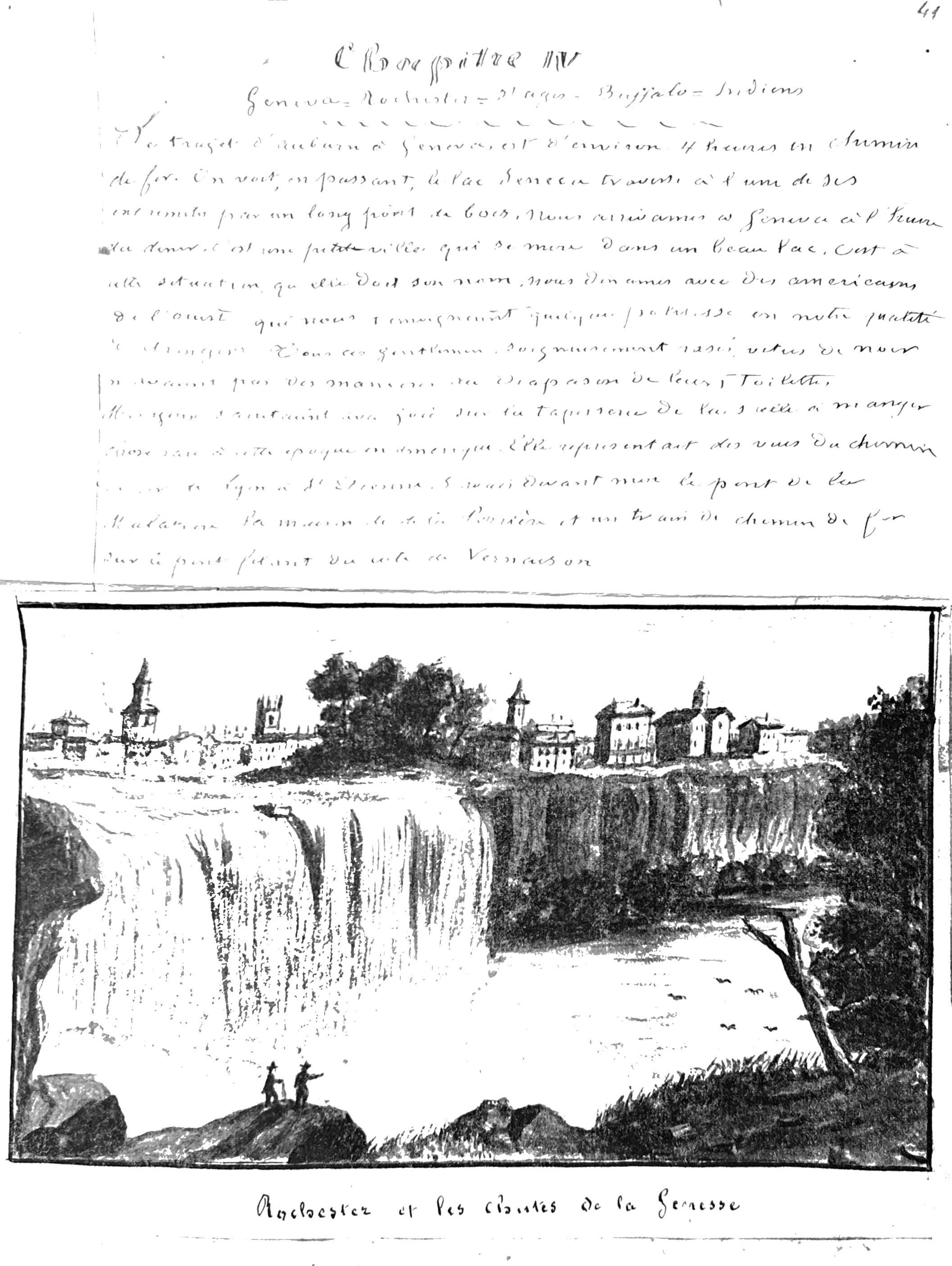
I do not tell you of a long and cold night passed in a Wagon [railway carriage]. We were at Rochester as dawn rose, yet without enough time before us to go and visit the falls of the Genesee. So we set off again almost at once for Batavia, where we alighted at 10 h. in the morning, after crossing a region of woods and wild lands. We left the railroad, to climb into the stage that was to carry us to Buffalo.
American stages are great carriages, generally painted red, with springs of the old fashion. They are drawn by four fine horses. They hold 9 persons: 3 on the back bench, 3 on the front one, and 3 on another hung from the roof of the stage.
The country is generally better cultivated in this portion of the state of New York than at the other points. The roads are none the better for it (1842) More than once, especially on the bridges made of tree trunks laid side by side, the jolts of the carriage, driven at a fast trot, sent our heads knocking against the upper wall.
We had as traveling companions an English lady and her maid, astonished at our French gaiety, plus 2 Americans, one of whom had the profile of Nero. His stern gaze turned on us whenever we began to laugh and joke.
We stopped on the way to dine in a bad hotel. We halted several times to let our winded horses, streaming with sweat, drink their ration of cold water.
As we stood before the door of an isolated house, waiting for our team to be fit to set out again, a traveler whom we had made out in the distance overtook us rapidly. He was an Indian, mounted on a small lean horse full of fire. There was nothing particular about his dress. His red-brown complexion, his narrowed eyes, his flat black hair, his great earrings recalled the distinguishing marks, of his race. He carried in his hand a little bundle wrapped in a red kerchief. He watered his horse without setting foot to the ground and without speaking to anyone. Then, striking his heels into his mount's flanks, he vanished at a gallop down a crossway that lost itself beneath the woods.
We arrived at Buffalo at 4 h in the afternoon, in the middle of a cloud of dust. The stages differ from our diligences [stagecoaches] in that they set each traveler down at his own door. Our Englishwoman alighted before a little house where the kisses of several children with delighted faces awaited her.
Buffalo lies on the shore of Lake Erie. Its streets are wide. Its port presents a spectacle of the greatest activity. One sees there vessels of considerable tonnage and some large steamboats. One of them burned last year (1841) in the middle of the lake with her 170 passengers. The port is protected by a breakwater, at whose end rises a lighthouse. Lake Erie stretches out of sight and merges, at the horizon, with the sky.
At Buffalo as elsewhere there were meetings and rehearsals of sacred music in the Protestant temples. We had come to Buffalo to visit a tribe of Indians settled at some distance from the town. We had resolved to make the run on horseback. We had to choose our mounts at a livery stable that counted more than 50 horses. The proprietor was a gloomy Presbyterian who had travelled in company with us in the stage. We fell asleep to the noise of fifes, of drums, to the sound of a discordant music. They were serenading a political personage who was lodging (?) at our hotel.
The next day we were on our feet at 4 h, and at 5 h in the morning two fine horses arrived prancing before the hotel door. "Well!" said my companion, "are you a good horseman?" "I am no écuyer [riding-master]," I answered him, "but these horses give me the impression of performing a fantasia [Arab horse display] for the gallery." Once in the saddle, we set off at a lively pace, more or less recovering our seat. For some time we followed, like two gendarmes, a carriage that was not going fast. Made impatient by this mania of our horses, we forced them to pass the carriage and then they went off at a gallop.
The morning was superb; the woods were wet with dew; there was a good smell of thyme and lavender.
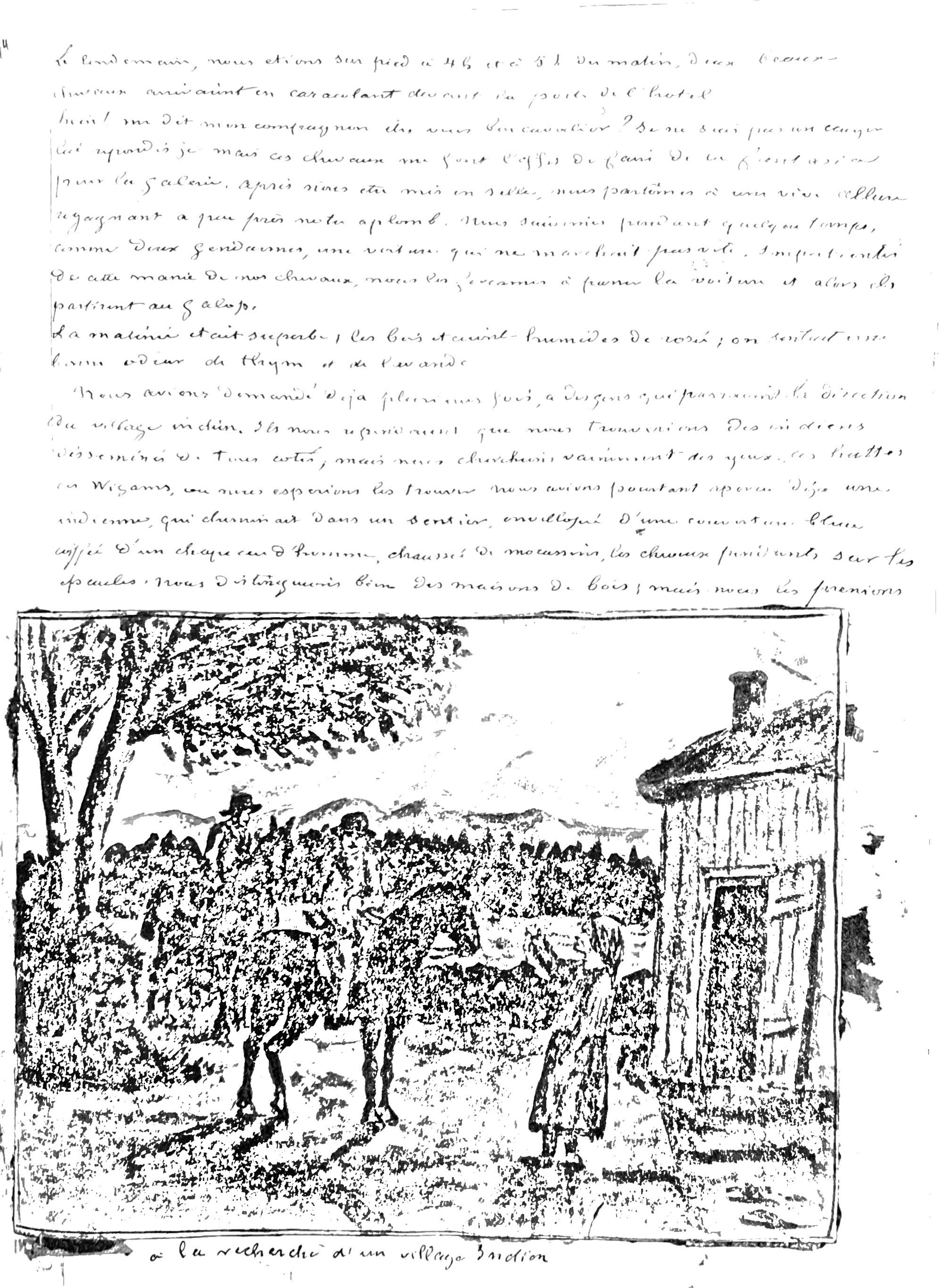
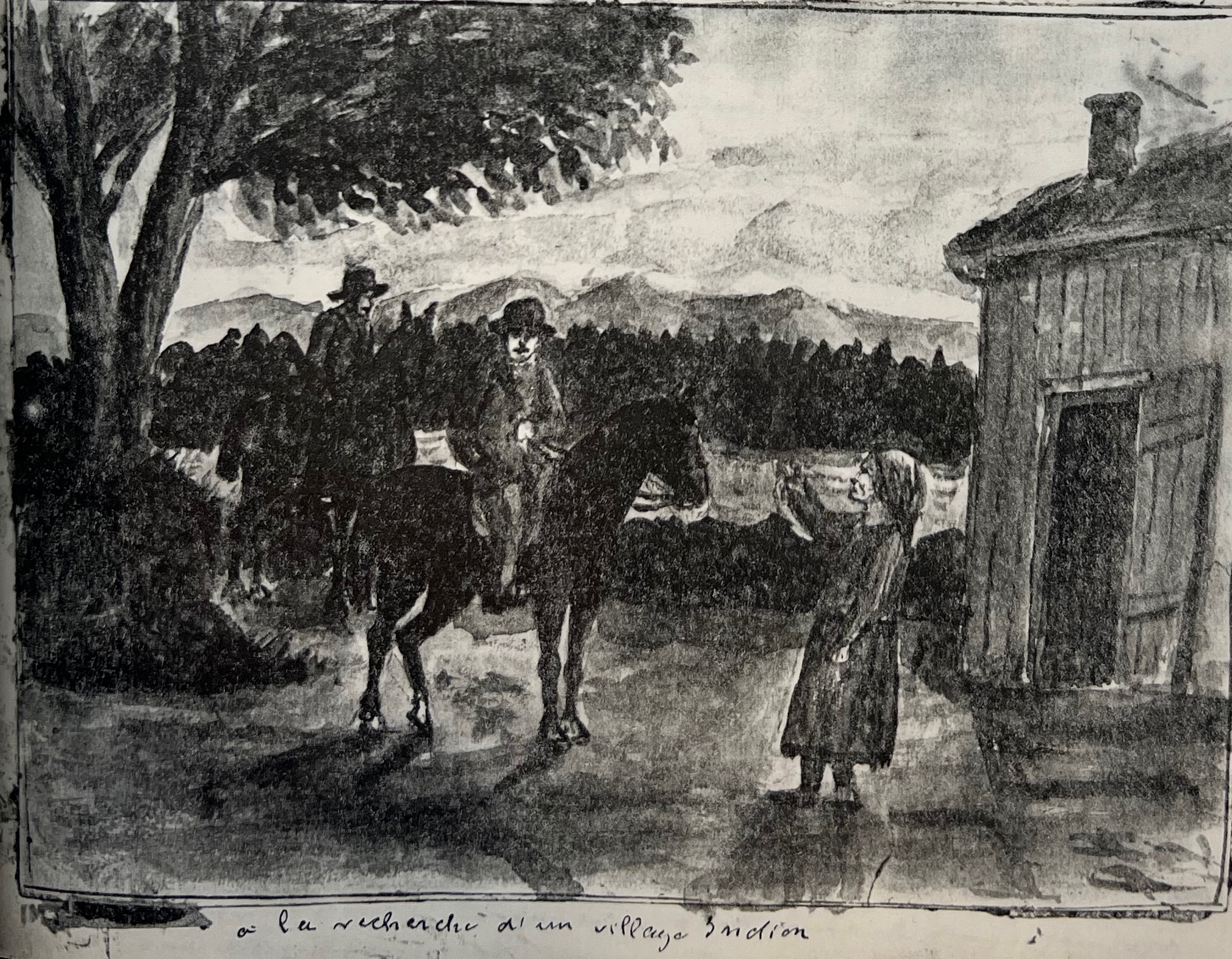
We had already asked several times, of people who were passing, the way to the Indian village. They answered that we would find Indians scattered on all sides; but we searched in vain with our eyes for the huts or Wigams [wigwams] where we hoped to find them. We had, however, already caught sight of an Indian woman walking along a path, wrapped in a blue blanket, capped with a man's hat, shod with moccasins, her hair hanging on her shoulders. We did make out wooden houses; but we took them for farms. Still looking for Indians with feathers on their heads: bitter Disillusion! They often passed near us, going to plough, recognizable only by their red-brown face, by their jutting cheekbones and by the ornaments hung at their neck.
 (opens enlarged view)
We were pursued, for some time, by half-wild horses which, having cleared the fence bordering the road, gave chase to our mares. Happily our mounts' pace did not flag, and in that cavalry charge we managed to rid ourselves of our squadron by turning down a path into the woods.
My mare put up partridges of the country from under her feet. My hunting memories came back to me. = Chance led us near some wooden cabins, surrounded by cultivated ground. We approached one of them. There came out of it an old Indian woman who had the aspect of the Sybille de Cumes [Sibyl of Cumae]. Her long grey hair hung uncultivated on her shoulders, framing her red face deeply wrinkled. A skirt of blue cloth, a camisole of indienne [printed calico] with large flowered patterns, leggings and moccasins composed her outfit.
The house, small and smoky, was like that of a poor peasant of the mountains of France. We asked the old woman for some directions to reach her tribe. She answered us in good English, gesticulating. Leaving her, we stopped before another wooden cabin. A tall Indian, crouched, busy milking a cow, received us with a smile of astonishment. Hens and a cart gave his dwelling an altogether civilized air.
It was 7 h. We had 8 miles to cover in 3/4 of an hour to reach Buffalo in time to board the Lake Erie boat. Our horses brought us back at a fast trot, at the amble, and at a gallop. We passed Indians going to the fields on carts. All wore as ornaments lead medals on their chests.
Back in Buffalo, having breakfasted with an appetite sharpened by our morning excursion, we were making our way on board the Waterloo, which was to carry us to the neighborhood of the falls of Niagara.