Chapter V
Niagara Falls · The Monument of Brooks · Behind the Great Fall
Lake Erie was azure blue; the sky was resplendent: our boat was to set us down, by way of a canal, in the neighborhood of the falls. Buffalo lies in the north of the state of New York on the shores of Lake Erie. As soon as the town and the lighthouse on the jetty are lost from view, one enters an arm of the lake which, narrowing little by little, takes the name of the Niagara River. Divided by a large island, the Niagara then forms a vast basin and goes on to make the falls that bear its name. It then continues its course for 10 or 12 miles and empties into Lake Ontario.
The banks of the Niagara after Buffalo are little broken. One skirts prairies scattered with clumps of woods. Nature offers a character of melancholy and of grandeur so well depicted in the works of Cooper.
At noon the boat entered a canal and stopped before a few houses. A few steps farther, we set foot on Canadian soil. Listening closely, one hears a dull rumble; among the trees one makes out white vapors that betray the approach of the celebrated cataract. We perceived English soldiers in red coats strolling with a stick in hand. A railway leads to Queenstown where we soon arrive; an omnibus carried us to the falls hotel on the Canadian bank.
Before arriving there, we have had through the woods a few glimpses onto the river, where its waters break against reefs before hurling themselves into the abyss hollowed out before them. Seeing that mighty river run amid the foam of the breakers, one cannot keep off a feeling of dread at the thought that this mass of water is about to become a cataract.
It was only on reaching the plateau that stretches before the hotel that we discovered the falls in all their beauty.
The Niagara forms a double cascade, divided by Goatisland île de la chèvre [goat island]. The wider of the two falls describes a half-circle. The waters seem to crystalize as they fall; clouds of white vapor rise from the bottom of that whirlpool where the eye no longer distinguishes anything. The scene is sublime. The more you contemplate it, the more you admire it.
We had two or three hours of daylight before us. We crossed the river in a light skiff to land on the American shore. Arrived at the feet of the 2nd fall we saw it grow greater still. These gigantic avalanches of water are of a frightening aspect. A few English riflemen guarded the point of the bank where we had embarked, blending into the dark greenery of those steep slopes. Near the American fall we found a wooden stairway backed against the sheer rock face. We leave at our feet the swirling water we have just crossed. It appeared black, one would say one of those lakes that Mythology placed at the gates of the underworld.
Climbing the wooden stair I have spoken of, the steps seem to tremble under one's feet. It is the effect of the atmospheric concussion produced by the enormous fall, whose profile stands out a few paces away.
On reaching the plateau we noticed a group of houses of elegant appearance. The flag of the United States floated at the top of a tall mast. Farther on one glimpses an industrial establishment, built on shoddy wooden pilings at the edge of the rapids that end in the fall.
Most travelers stop there, by the railway that comes straight to the American bank. Patriotism and fashion command them to alight half an hour from the falls. On the English bank we were better served: by raising ourselves on one elbow we could see the falls from our bed.
A wooden bridge, thrown across the rapids, American side) leads to goat island, which separates the two cataracts. It is covered with luxuriant vegetation. Never had I seen such beautiful trees, which have grown in freedom under the eye of God. They sell in little cabins along the edge of the island's path, articles in cork, moccasins embroidered with beads, works of the civilized Indian women of the neighborhood.
While walking in the forest; I gathered there two little wild flowers that were destined for you. Later, crossing Lake Ontario, finding them wilted, I threw them into the water. I regret it today I could have put them in my letter, at the end of goat island, one finds a wooden staircase, which descends to the bottom of the precipice. One penetrates a little further, into a fairy grotto all hung with stalactites of bizarre and varied forms. Following the path that runs along the edge of the island, one arrives at the horseshoe fall. A little wooden bridge, thrown — I do not know how — across the breakers, lets you see the water that hurls itself toward the abyss and one arrives at a wooden tower that rises fragile, in the midst of this upheaval like a testimony to the energetic will of man in this new country.
From the top of the tower the spectacle is dizzying and truly terrifying. The masses of the river's water — very broad at this point — arrive churned by the breakers, leaping, foaming, and hurl themselves with an immense roar into the abyss. The vapors rising in whirls before you drench you in a fine rain that reflects the colors of the prism and robs you of the view of the opposite bank.
The sunlight sparkles in the waters of the cataract, which appear like an avalanche of diamonds.
From the tower one also makes out the rapids, which stretch to a distance of 3 miles above the fall. I could see a small wrecked ship motionless in the breakers, her prow lifted toward the sky. An American launched her into the current by subscription, 8 months ago. Only, the ship — instead of reaching the cataract, where the spectators' anxious curiosity awaited it — remained grounded on the point of a rock. The speculation was none the less a good one for the Yankee.
We came back on our steps, still admiring the beautiful shades of goat island, greeting here and there the squirrels that gamboled and leapt in the branches. Returned to the Canadian bank, we took advantage of a fine evening to visit the Whirlpool and the monument of Brookes.
 (opens enlarged view)
The surroundings of our hotel — woods, meadows, cultivated fields — made an agreeable picture. The Canadians we passed answered our questions obligingly. They had none of the proud coldness of Americans of the same class.
The Niagara, after the falls, flows for some time between high mountains; then it describes a curve and forms as it were a little lake, or rather a gulf with deep waters. The whirlpools which eddy up in it on every side have earned it, in English, the name of Wirlpool. The gulf is dominated by sheer heights, crowned with a thick vegetation where one sees above all firs with sombre foliage.
Placed upon a rock, we saw several tree trunks that turned round in the gulf without changing place, as if in the grip of a long agony. Now they disappeared in the waves, now they raised to the sun their foaming and streaming heads. We were told that the corpse of an English soldier who had drowned in the Niagara had been seen turning a long while in those whirlpools.
The cry of a bird of prey, which flew heavily above our heads, added a wild character of this corner of landscape.
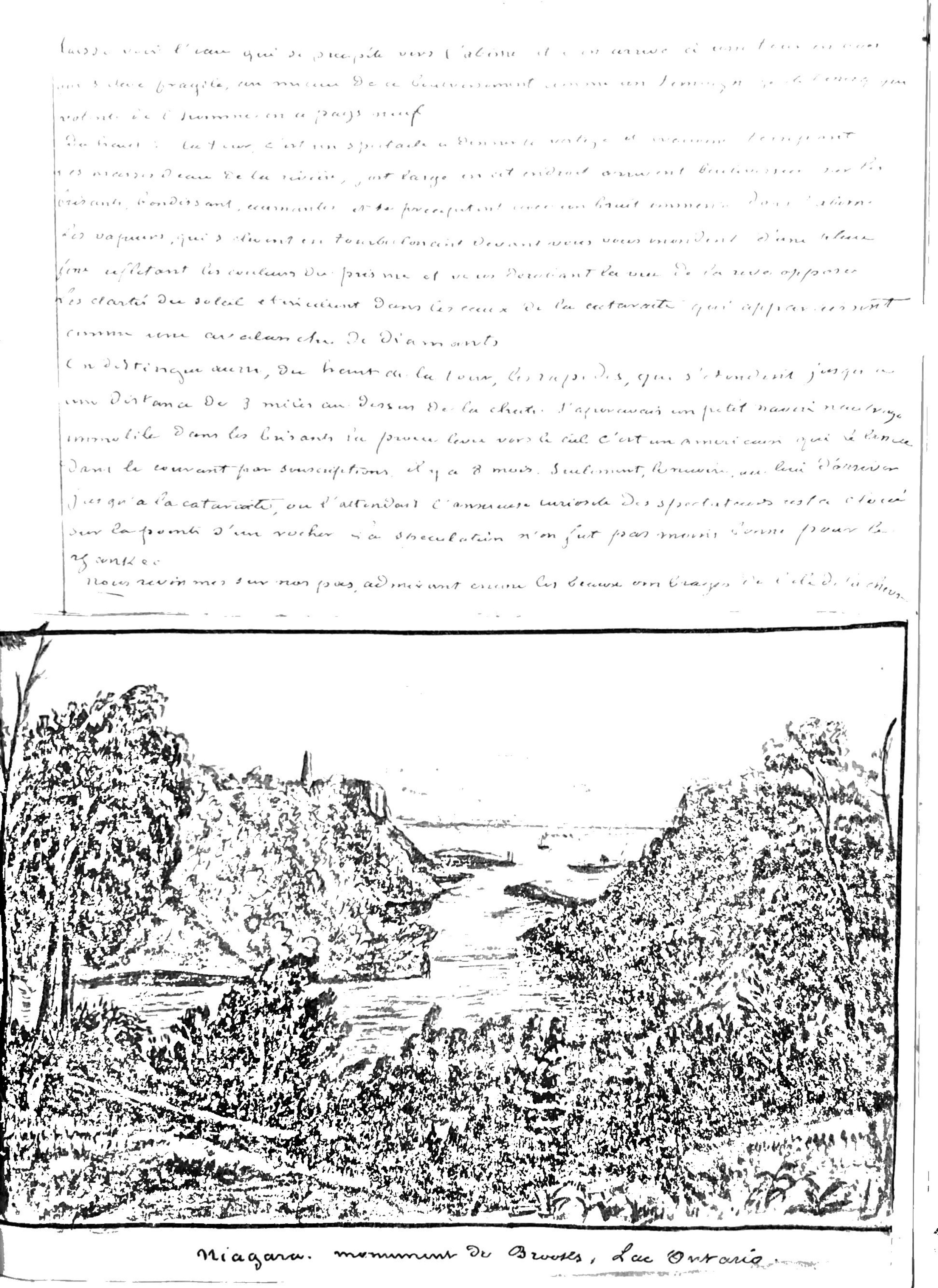
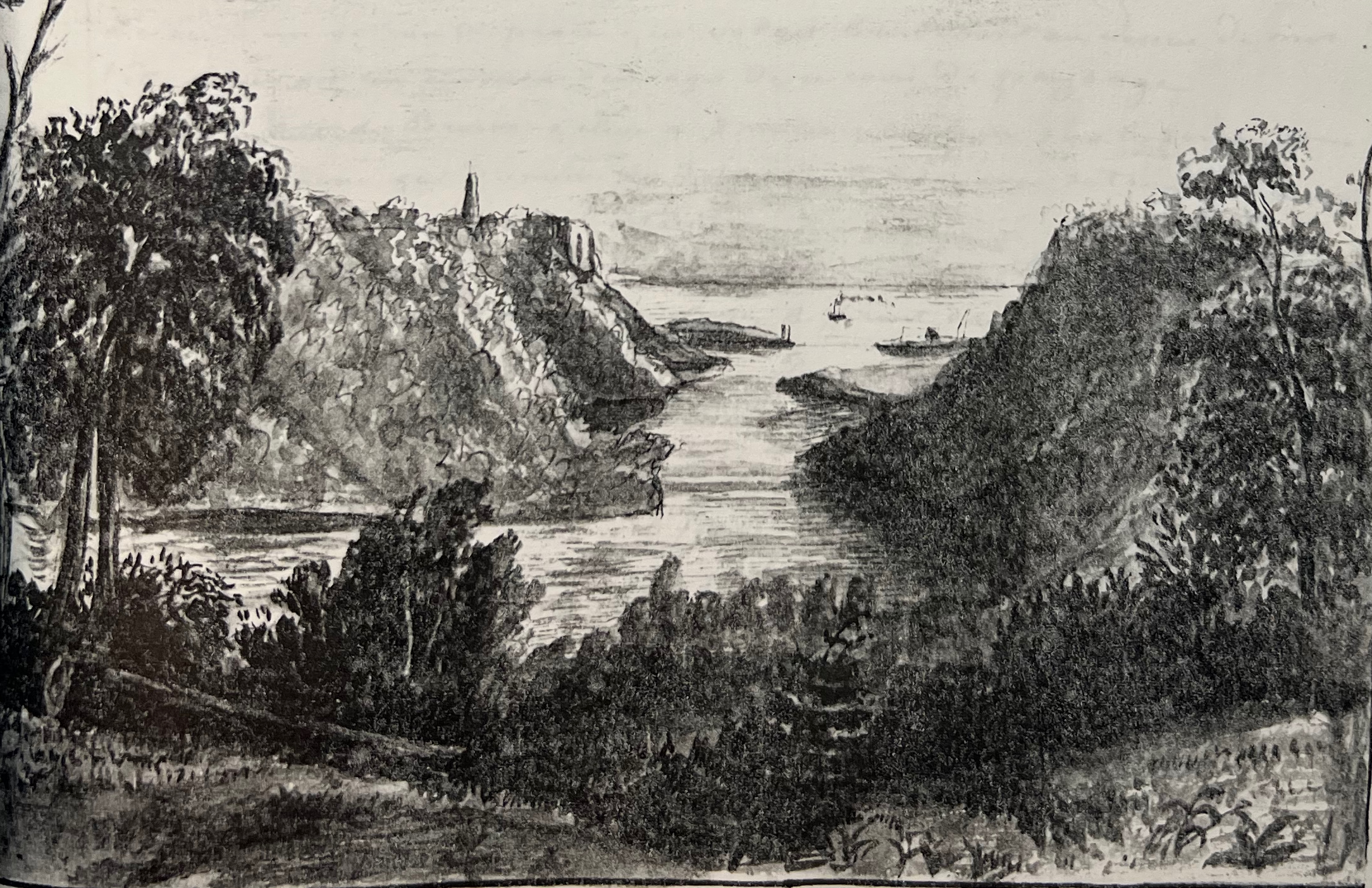
The monument of Brooks rises 3 miles farther on, at the summit of a mountain commanding a defile where the Niagara runs pent in on its course toward Lake Ontario.
The monument is now no more than a ruin, ready to collapse. The Canadian patriots, in revolt in 1837 against English authority, blew it up with kegs of powder. It was once a tall column raised to the memory of gal [General] Brooks, who died on this spot during the war of 1812.
The Americans, camped at Lewiston, had formed the plan of seizing Queenstown. Unable to cross the river, under the enemy's fire, they went back up it as far as the place where it sinks into deep gorges and began to climb the flanks of the opposite mountain. Unfortunately for them, the English had seen them. A hail of balls and round-shot awaited them at the summit of the mountain. The English, aided by the Indians, had no trouble in hurling them into the river. General Brooks died pierced by a stray ball.
From this point one commands, far off, Queenstown and Lewiston. The Niagara, a long blue ribbon, loses itself in a bay of Lake Ontario, which at that hour reflected, all the way to the horizon, the flaming tints of the setting sun.
Returning to the hotel, we walked for a while along the edge of the path that runs beside the basin of the falls. Soon drenched by the fine rain of water-vapor the wind was driving our way, we went back in. In the parlor we found an English family: an old infantry captain with his wife and daughters. They welcomed us cordially. The parlor's old piano was put into requisition to brighten the evening, but the sound of its cracked notes faded away, and our ears heard only the continuous bass of the cataracts' roar. The windows trembled in their frames. The ladies told us that they had been living at the hotel for 2 years, and that the more they saw the falls, the more they admired them.
One of the young ladies told us, while petting a kitten, that she was almost pained at having to return to England following a change of garrison. She had passed nearly her whole life in Canada and was happy amid these beautiful solitudes. We pitied them their isolation; they answered by speaking of the pleasures of winter — the sleighing parties, the young officers of the regiment, the colonel's balls.
We fell asleep; the falls of Niagara sang us a lullaby.
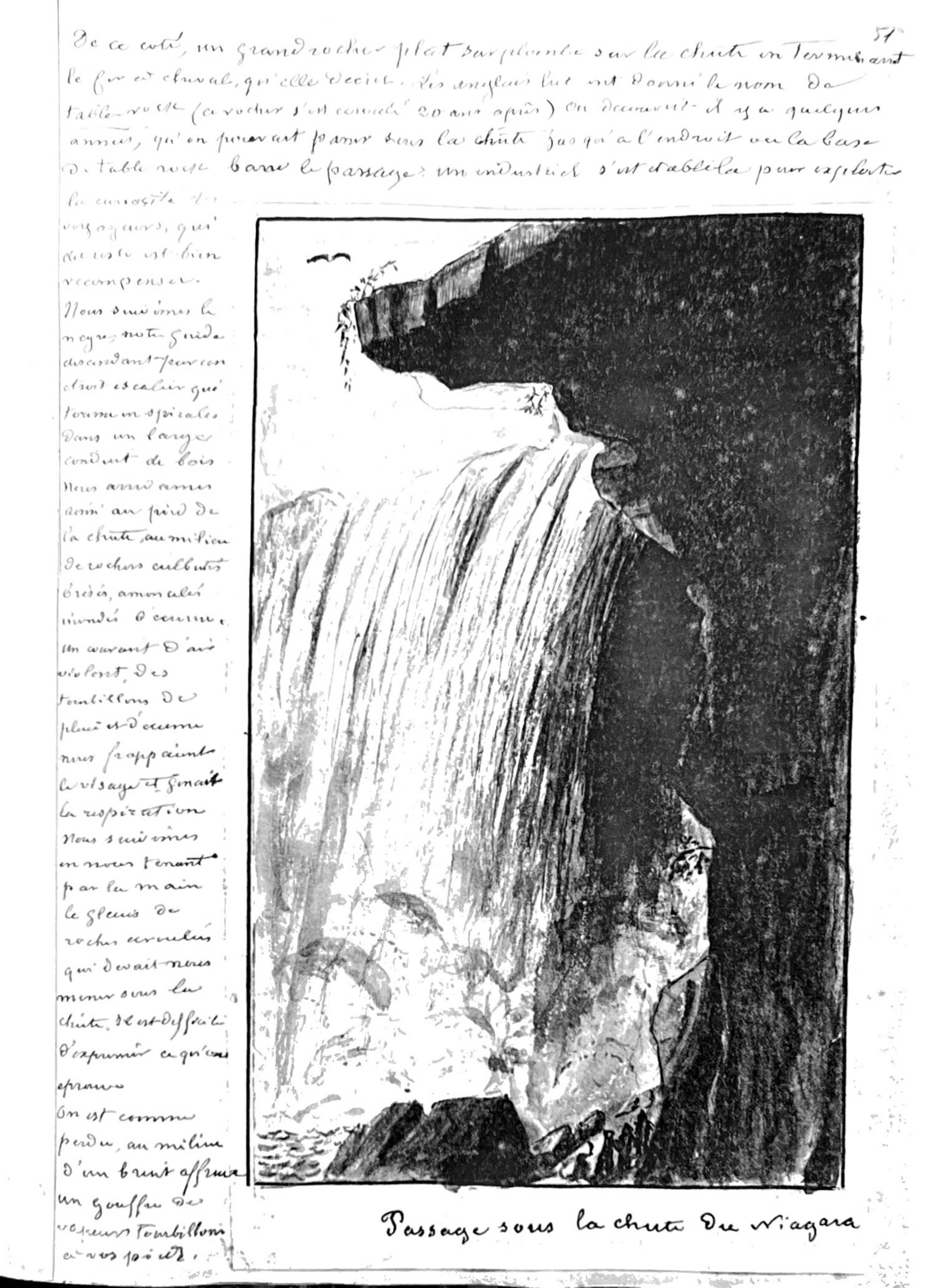
The next morning it remained for us to pass behind the sheet of water of the great fall. Arrived at a wooden hut close by, we had to change our costumes. We were offered a garment with which we could brave the furies of the gulf: a red wool shirt, trousers of canvas, stockings. of blue wool, a bad hat, a waterproof overcoat with the hood pulled down over the headgear, a rope by way of cravat, a rope for a belt. It was the masquerade; we could not look at one another without laughing. As a scene of manners, I must tell you that the owner of this wardrobe — a man of hard countenance — knocked the cap off with a slap, of the negro who was to serve us as guide, because he was keeping his cap on his head. On this side a great flat rock overhangs over the fall, ending the horseshoe that it describes. The English have given it the name of table-rock (this rock collapsed 20 years later). It was discovered a few years ago that one could pass under the fall as far as the place where the base of table rock bars the way: an entrepreneur has set himself up there to exploit travelers' curiosity — which, for that matter, is well rewarded.
 (opens enlarged view)
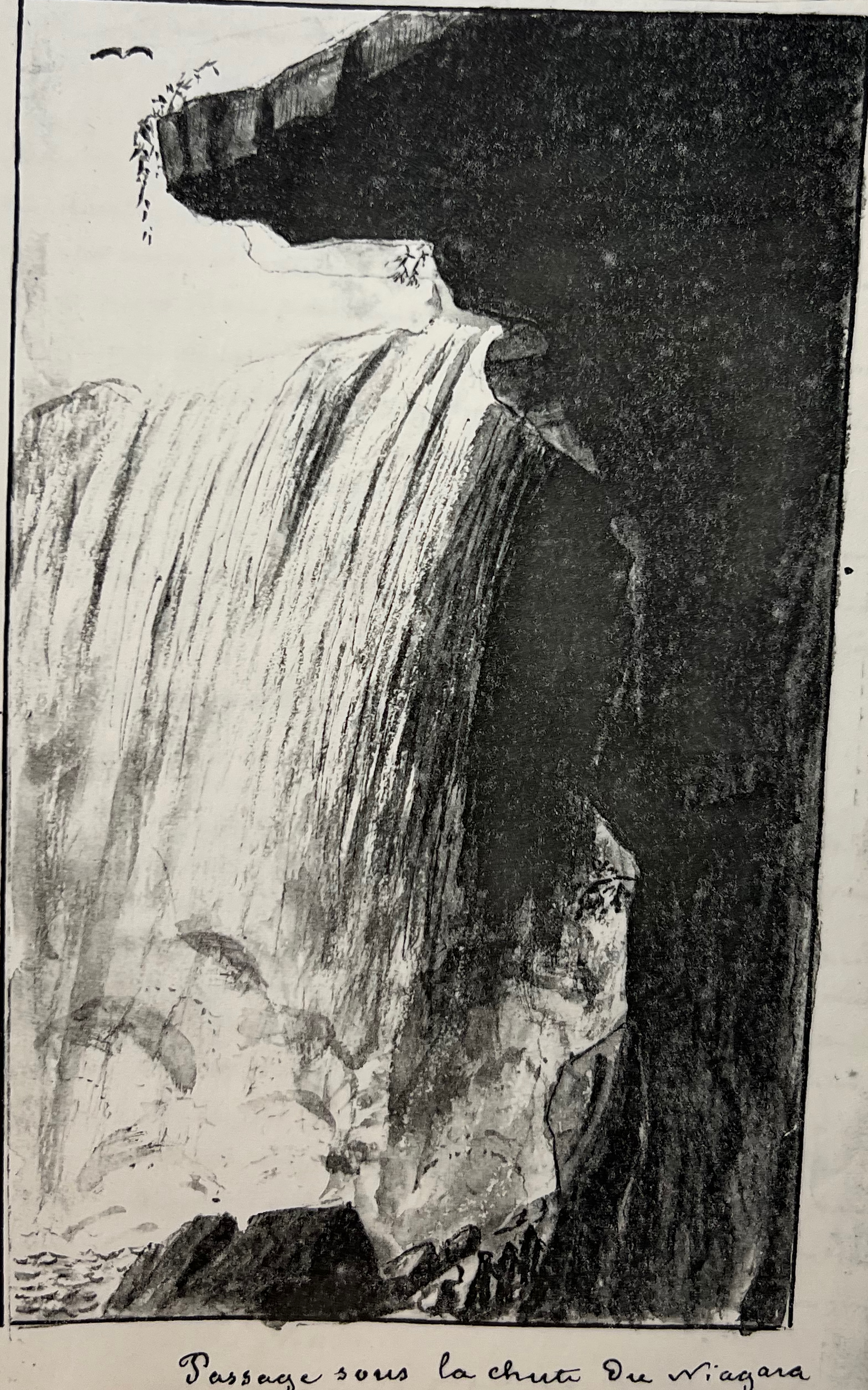
We followed the negro, our guide, going down by a narrow stair that turns in spirals inside a broad wooden shaft. We came thus to the foot of the fall, amid rocks tumbled, broken, heaped up, flooded with foam. A violent draft of air, whirls of rain and of foam struck our faces and hindered the breathing. Holding one another by the hand we followed the glacis [scree slope] of fallen rocks that was to lead us under the fall. It is difficult to express what one feels. One is as if lost, in the midst of a frightful noise; a gulf of vapors whirls at your feet. We stopped an instant, turning our backs, to catch our breath. The negro laughed, showing his white teeth. He asked us whether we had had enough of it. He advised us with a hypocritical air to turn back on our steps. One heard him with difficulty in the midst of that din. We shouted "Go" — onward. We advanced in this way to the curtain of the falls, where the draft was less violent than at the entrance. A chain had been fixed in the rock to hold on by. It no longer exists; the vibrations have shaken and unsealed the rings which fixed it.
 (opens enlarged view)
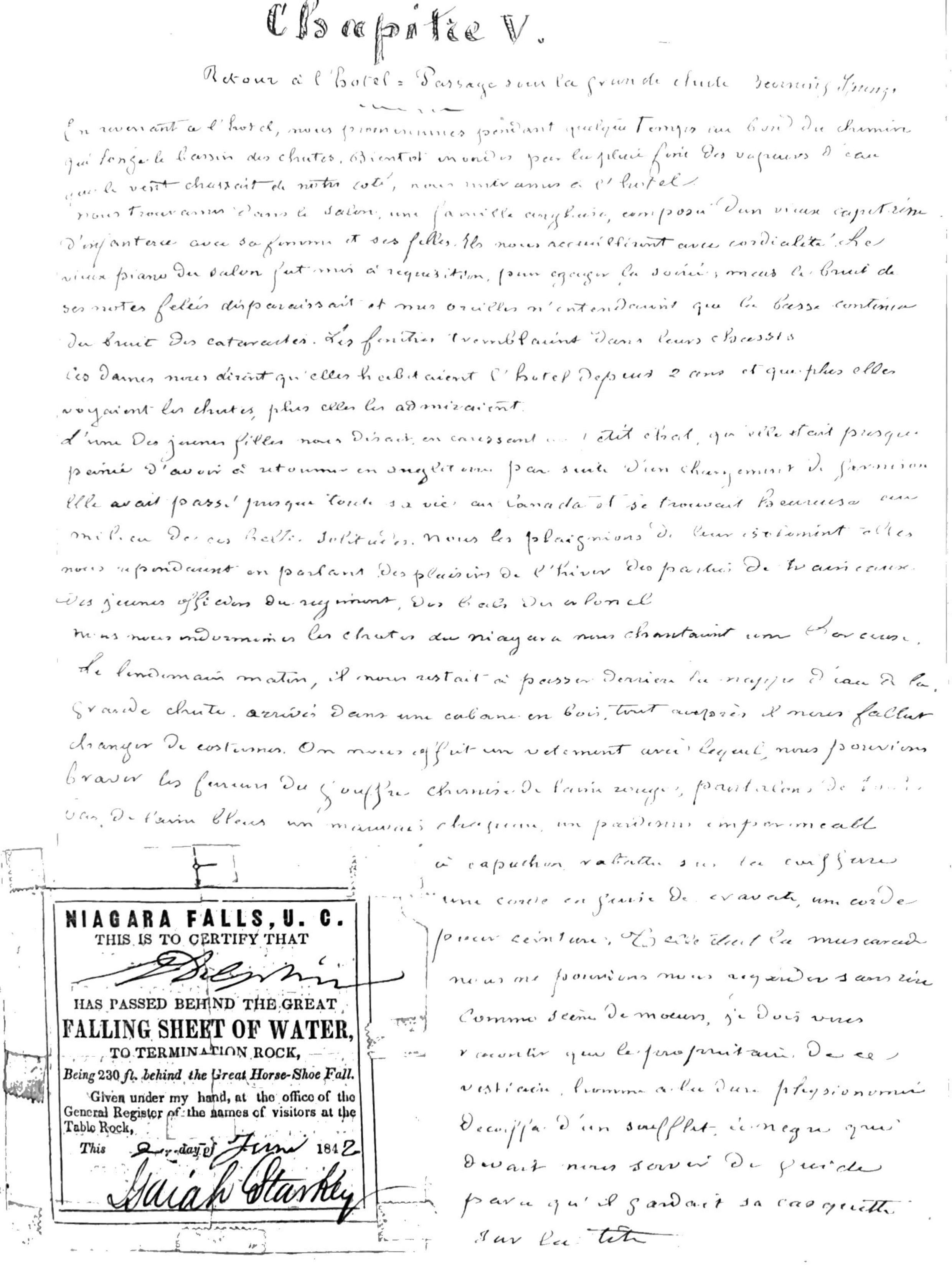
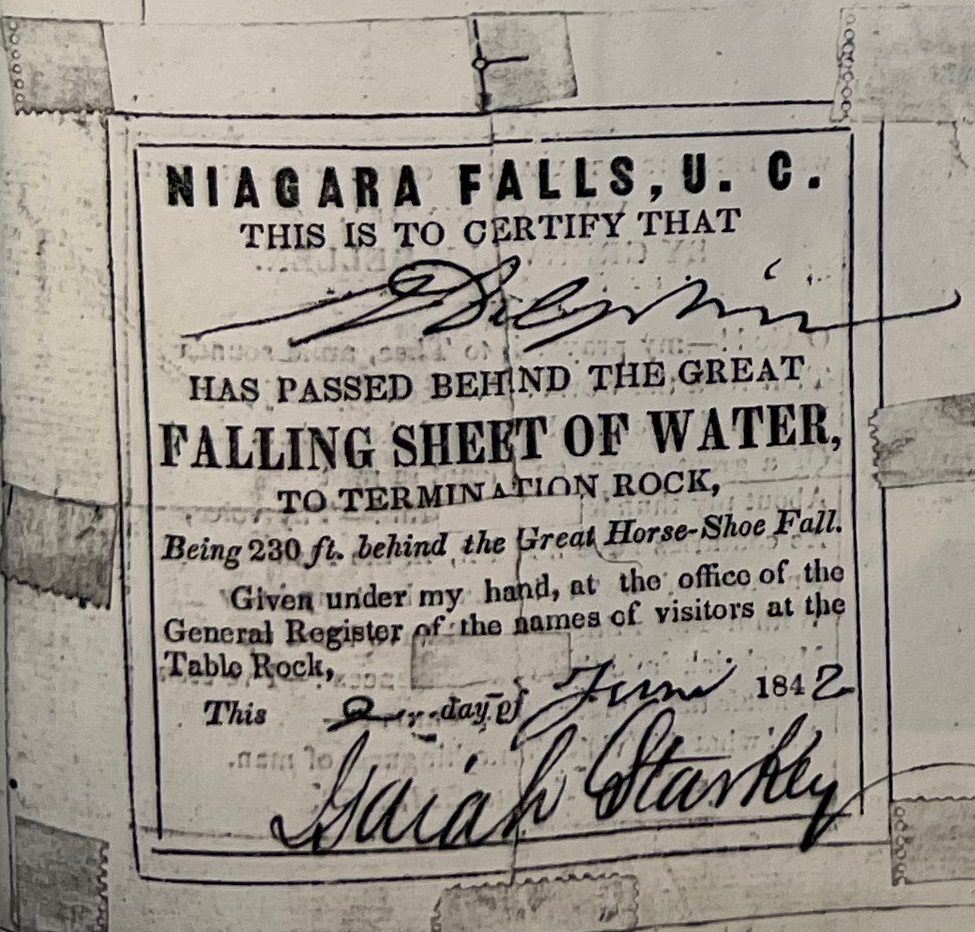
We made out nothing but a transparent deluge. We came out of that chaos out of breath, streaming with sweat. We took our clothes back in the hut of the Docteur - es - chutes [Doctor of Falls]: we signed with a trembling hand our names in the register lying open before us and each received a certificate included in the price of the excursion, it is to be seen above.
In the afternoon we went to visit the hot water springs (Burning spring). A great quantity of hydrogen gas comes off from them. On presenting a light above the tube of the springs, one sees the hut in which one is shut suddenly lit up; a sulfurous smell suffocates you.
We came back crossing meadows where English soldiers were drilling; a few trumpets mingled their fanfares with the dull noise of the cataract. We decided, at the hour of going to bed, to leave the next day for Toronto.