Chapter VII
The St Lawrence · Montreal
Almost as soon as we were out of Kingston, we entered the St Lawrence. The boat passes, at this point, through thousands of islands, among which the river traces its course in capricious branches. These islands multiplied as we advanced; some are broad, crowded with a powerful vegetation; others are mere rocks covered with moss, plumed with stunted trees. For 4 hours we held our way through this landscape, as strange as it is enchanting.
These solitudes were troubled only by the noise of the boat's wheels and the waves they left behind them.
Once out of this labyrinth, the St Lawrence flows peacefully between vast meadows strewn with clumps of trees. We stopped opposite several villages of poor appearance and miserable. Already we noticed a greater number of crosses on the churches, which told us we were approaching Lower Canada, French and Catholic in origin.
At times the banks of the St Lawrence, flattening to the river's level, let us make out in the distance immense forests and great fields of wheat. Passing near some village or other, we noticed a wooden barracks planted on an island like a vast dovecote. The soldiers' red coats stood out against the surrounding green.
A little farther on we were assailed by a cloud of mosquitoes. Impossible to give you an idea of their numbers and of the fury with which they pursued us. The ship's deck was black with them; our clothes were covered. We were obliged to take refuge in the cabin to escape them. This lasted for a space of three miles; the captain told us he found them always at the same spot.
Toward 2 o'clock we shot a line of rapids produced by the river's fall. The boat flew like an arrow through the foaming water.
Here and there one saw canoes hollowed from tree trunks resting on the bank. Old boats were working their way upstream under sails black with age and often patched.
 (opens enlarged view)
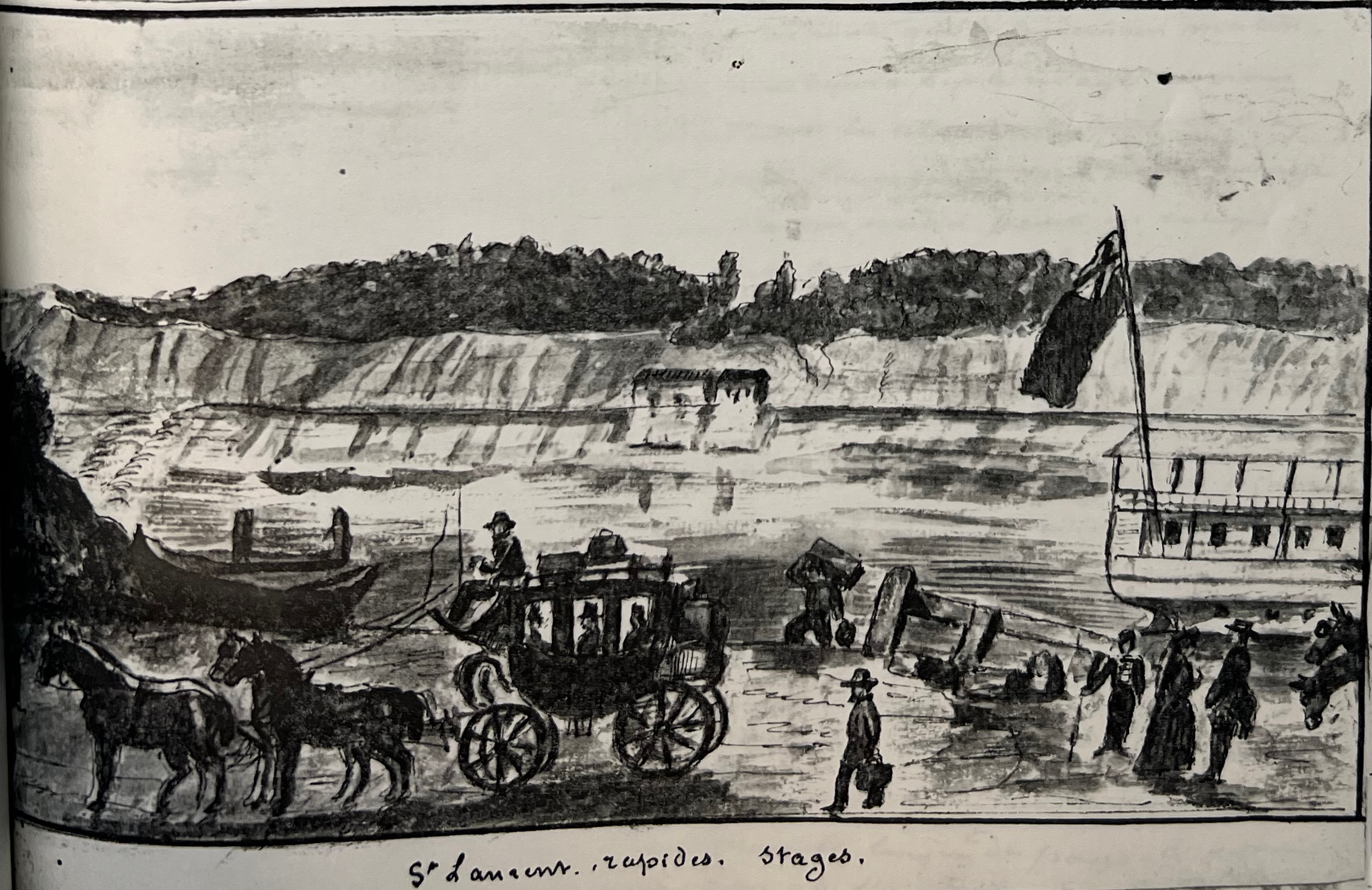
We arrived in the evening near a group of houses; four or five stages were waiting for the travelers. The boat stops there, unable to pass a line of rapids stretching several miles below that point. I had for neighbor a young French count returning from Mexico, who had covered the whole United States in thirty days. He was going back to New York to spend there, he told me, a month or two of rest and pleasures. I predicted he would not stay a week. My prediction came true. On reaching New York I saw his name among the passengers departed on a Le Havre packet.
The farms we glimpsed in passing were wooden houses blackened by time. The women wore great straw hats and the calico dress, instead of the bonnet and the silk dress of the American farmers' wives. Children herded cows, pigs and turkeys round about.
The most curious thing we saw on the way was an encampment near a place where a canal was being dug. Huts of branches rose on every side; the women were preparing the day's last meal in the open air; children played around the fires where the cooking-pots steamed. More than two hundred navvies were coming back with the pick on the shoulder. The slanting rays of the setting sun lit the scene in the warmest tints.
We left our carriages at 9 h in the evening to board the fine steamboat Highlander, which awaited us at the end of a point isolated and solitary. We were sleeping in our cabins a sleep all the calmer in that the boat did not get under way until next morning.
After a run of 4 miles, the boat set us down on the shore, where carriages were waiting for us. At that spot eight or ten Indians sat in a ring on the sand. Their canoes, drawn up on the bank beside them, were nothing but hollowed tree trunks, painted red, flying the English flag at the stern. It was not without a certain pleasure that I saw feathers on the hat of the youngest of the band — I, who always dreamed of Indians with feathers on their heads. They were poorly dressed; their moccasins gripped the bottoms of their canvas trousers. Their long hair, black as a raven's wing, framed their faces red rather than brown. They were doubtless waiting for two Indian women whom we met farther along the road. They were wrapped in wool blankets. Their long hair hung in disorder over their felt hats. They were embroidering moccasins; a child, half naked, was stirring up the lean horse of the charriot [cart] that carried them.
The carriages brought us aboard a 3rd boat, which was to carry us to within some distance of Montreal. It was there that we began to hear French spoken. It was still the language of the country. It was a pleasant surprise for us, though the Canadian accent seemed to us to demand a careful ear to understand well what was said to us. Two old ladies dressed in black, a few newly come passengers smiled, on hearing us speak the language of the great nation. Our captain, a jovial man, was delighted to show us he spoke French. The St Lawrence widens greatly from this point, and will soon carry great ships come in from the Ocean. We were passing a tug surrounded by a flotilla of barges pressing close around it like daughters around their mother. They carry emigrants come from afar, and English soldiers going to rejoin their garrisons.
Flights of wild ducks furrowed the sky. The St Lawrence, widening still further, takes the name of Lake St Francis. At two o'clock we land, and carriages carry us to Montreal. The road linking the landing to the town is macadamized. I could not tell you the pleasure I felt on entering the town. It is altogether an old French city: houses are built like ours; one sees there narrow streets like those of Lyon. One reads shop-signs, in French.
Scarcely arrived at the hotel, we ran out to see the town. One of the first persons we met was a fat ecclesiastic in a cassock — a thing one never sees in New York. The street names are written on plaques, in French on one side, in English on the other. Here are a few of those street names: Rue St Francois rue de la Reine, rue Royale etc. The English language is the only one recognized by the government; but the common people speak French among themselves, with a strong Norman or Burgundian accent.
Montreal is governed on the English administrative system. At intervals one sees policemen in embroidered and numbered coats. The town has a strong garrison. The only curiosities of Montreal, for the Americans, are its convents, its colleges, its cathedral and its quays.
The convents had not for us the attraction of novelty. We went to visit the cathedral. It is, with Baltimore's, the largest church in North America. It rises, like a colossal mass, above the slated roofs of the town. It is Gothic in style; the interior does not answer to the exterior. A service was being celebrated there that day. The nave was pretty nearly full. We found again there, with pleasure, the types of the old ladies and the old maids of the provinces — antique hats, outmoded gowns, greasy books &c
The quays of Montreal are well laid out and built of cut stone, very superior to the ugly wooden quays of New York.
One saw moored there a score of big ships arrived from London and Liverpool. At the bow of a departing boat we noticed a group of Indians squatting and lying in every position. We met a great many of them in the streets, walking noiselessly, feet turned slightly inward. We also saw several Indian women, prettier than those we had met until then; they seemed to have more coquetry. One of them, a girl of about twenty, went into a shop. We admired the regularity of her features and the expression of her gaze.
All these Indians belong to Catholic tribes settled on Canadian soil, where they are not hunted, pursued into the wilderness like the American tribes.