Chapter VIII
Lake Champlain · Ticonderoga · Lake George · Saratoga · Return to New York
We left Montreal the next morning. A steamboat crossing the St Lawrence brought us to La Prairie, where a railway train waited to set us down on the shores of Lake Champlain. The country one crosses on the way is generally well cultivated. Arriving at the station we saw a poster in French that amused us greatly. It concerned a malefactor who had burned a bridge!! The shériff [sheriff] offered 100 dollars to whoever would deliver into his hands the author of this diabolical act. The poster's style went always crescendo. The shériff worked himself into a rage, so that by the end it was an incomprehensible mess — the style of a madman or of a drunkard.
We dined on reaching the shores of Lake Champlain, in a hotel whose name I have forgotten. Its look was bleak and dreary. The hotel made a good appearance; the cooking was careful; on the table one saw wine — such as is never given in the United States.
We boarded the steamboat Whitehall to cross Lake Champlain. This boat passed, with good reason, for one of the finest in North America. It would take too long to describe to you the luxury that reigned aboard. We were only 6 passengers to people her immense saloons - The bow of the boat was crowded with emigrants going from Canada to the United States.
Lake Champlain, thus narrowed at the start, seemed to be no more than a river. A little after it widens and becomes a beautiful lake without losing sight of shores. It is surrounded by high mountains covered with forests. Admiring their peaks veiled as with a gauze of mists, I thought of all the game that must people those vast solitudes. In the midst of the peaceful waters one saw islands crowned with greenery. An old lighthouse raised its head among the trees of one of them.
Toward evening we put in at Burlington to take on wood. It is a small village; but the activity that reigned there, the light carriages to be seen on the port, showed plainly enough that we were re-entering American soil. We listened with pleasure, none the less, to the men of the crew — good Canadians — talking and joking in French.
At Burlington our boat was immediately invaded by some sixty passengers in black coats and white cravats. They were Methodist ministers returning from a great meeting where questions of doctrine had been treated. One of them foisted on me [illegible: ~4 chars] fifty-four pages of print. This factum [polemical pamphlet] dealt with a discussion, dating from the month of November, between a Methodist minister and a Universalist on the subject of predestination. It was an excellent soporific; I was falling asleep. I took up a newspaper by way of diversion; the minister never took his eyes off me. Having administered the pill, he wished to observe its effect. It was nil.
At 9 in the evening we were left more or less alone on deck when a noise of nasal singing drew us to the cabin stair. It was the 60 Methodist ministers singing psalms, arms crossed on their chests, their air contrite but not humbled. One of them then took the floor to exhort his brethren. I still see Walter Scott's puritans. Going back up on deck we found the best bench occupied by a fat minister who was dozing, unaware no doubt of what was going on in the cabin. By dint of noise we managed to draw him from his somnolence; but he was no more moved than a monk who had missed the office, on hearing the pious chants — more and more strongly marked, and nasal as ever. We learned shortly after that this fat minister was the reverend Onderdonck, Episcopal (Anglican) bishop of New York. He had nothing to do with the Methodists.
 (opens enlarged view)
From time to time the boat drew near the shore to set down one or two ministers, doubtless in the neighborhood of their parishes. The mountains in the night seemed taller; their black shadows invaded the waters, leaving only a small space where the sky could mirror itself. At midnight we went down ourselves into the steamboat's little boat — the bishop too — at Ticonderaga, on the way to Lake George. The boat's small windows, brilliantly lit, threw their flickering gleams on the water. Soon she shook herself and departed, vomiting torrents of sparks from her funnels.
On landing we found, at the foot of a little path, the master of the hotel waiting for us, lantern in hand. This hotel stands quite alone and fills with people only in the summer months.
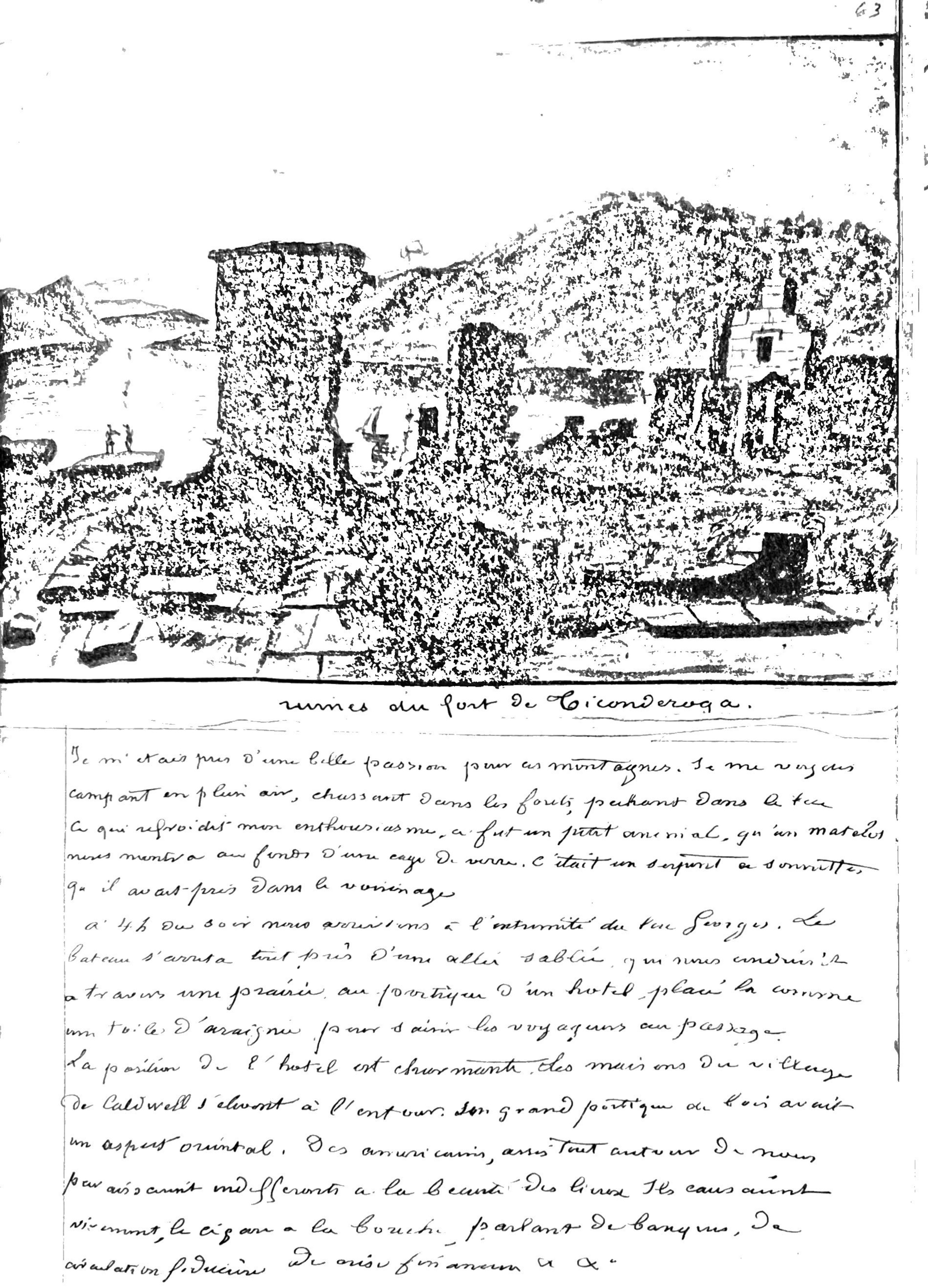
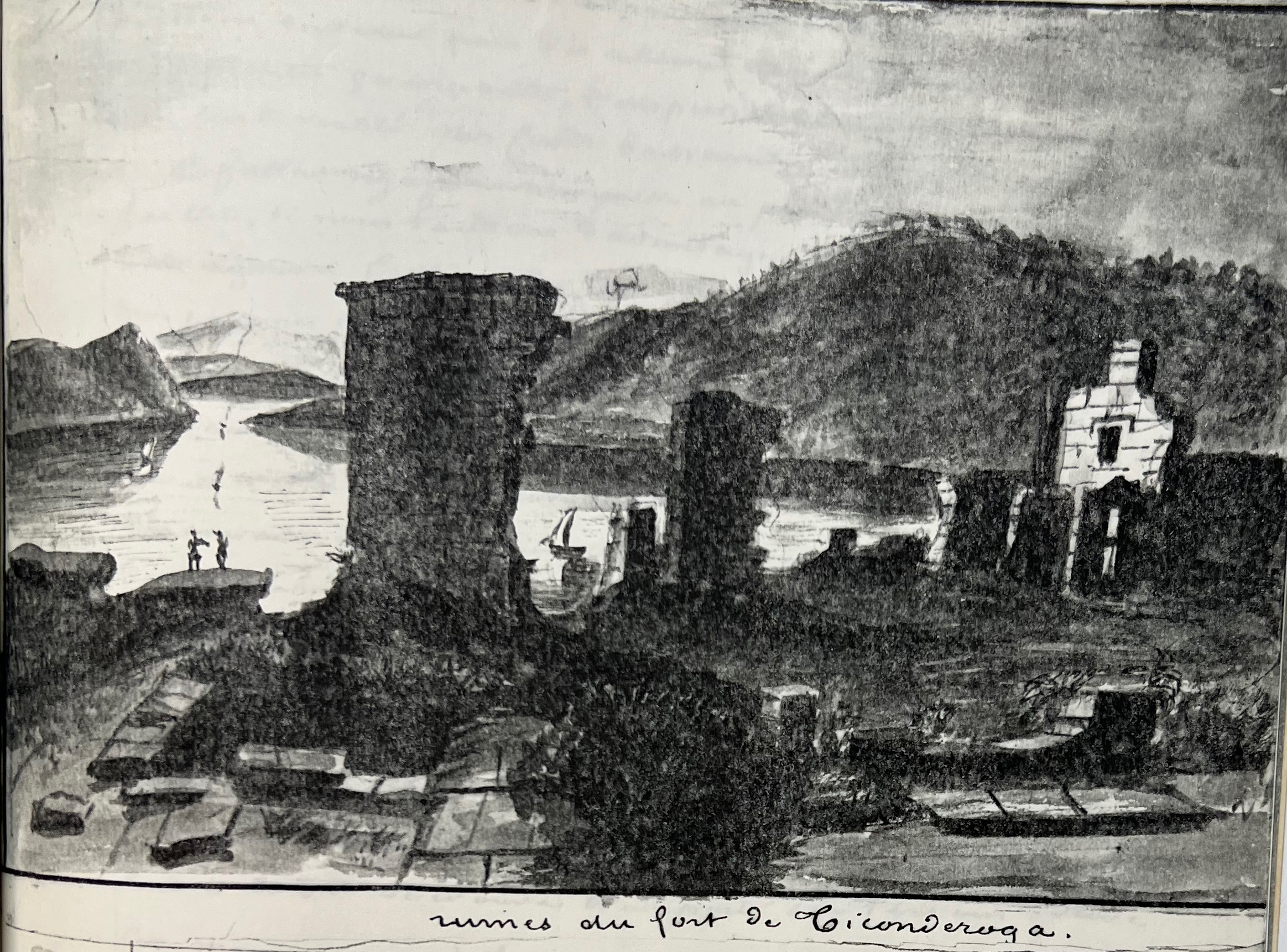
The village lies on the slope facing Lake George. We found good beds at the hotel. The furnishings were summer ones: carpets and curtains were replaced by Chinese mats and blinds. The next morning we went to visit the ruins of an old fort on the shores of Lake Champlain; its destruction dates from 1812, the period of the war with England. It seemed strange, in France, to see forts thus lost in the wilderness; but one must recall the origin of the United States and the conflicts with the Indians, which demanded strongpoints. Cooper's novels, whose scenes are set in these regions, give an idea of it. We noticed an old rusted cannonball lost in the rubble. The waters of Lake Champlain stretched at our feet. The fort had been built by the Americans at the time of the wars of independence, and the people of the country even show us the trace of the redoubts that were occupied by the French.
We nearly caught a little squirrel that came to watch us mischievously on the mound of lawn where we sat.
On our return, the master of the hotel showed us a bache [tarpaulin] filled with the cannonballs and bomb fragments gathered in the neighborhood.
Our hotel, agreeably situated, stood in the middle of an English garden. We put a little flat-bottomed boat in the water and took a charming excursion, rowing lazily. We set off again by carriage toward midday to reach the shores of Lake George; the country is broken. The houses of the village of Ticonderaga are scattered amid immense meadows. The road follows the foot of the mountains, which border them, to reach the lake, which lies on the other side of that high chain.
During the passage on Lake George, one of our traveling companions pointed out to us a stag climbing at a gallop the steep slopes of a coppice.
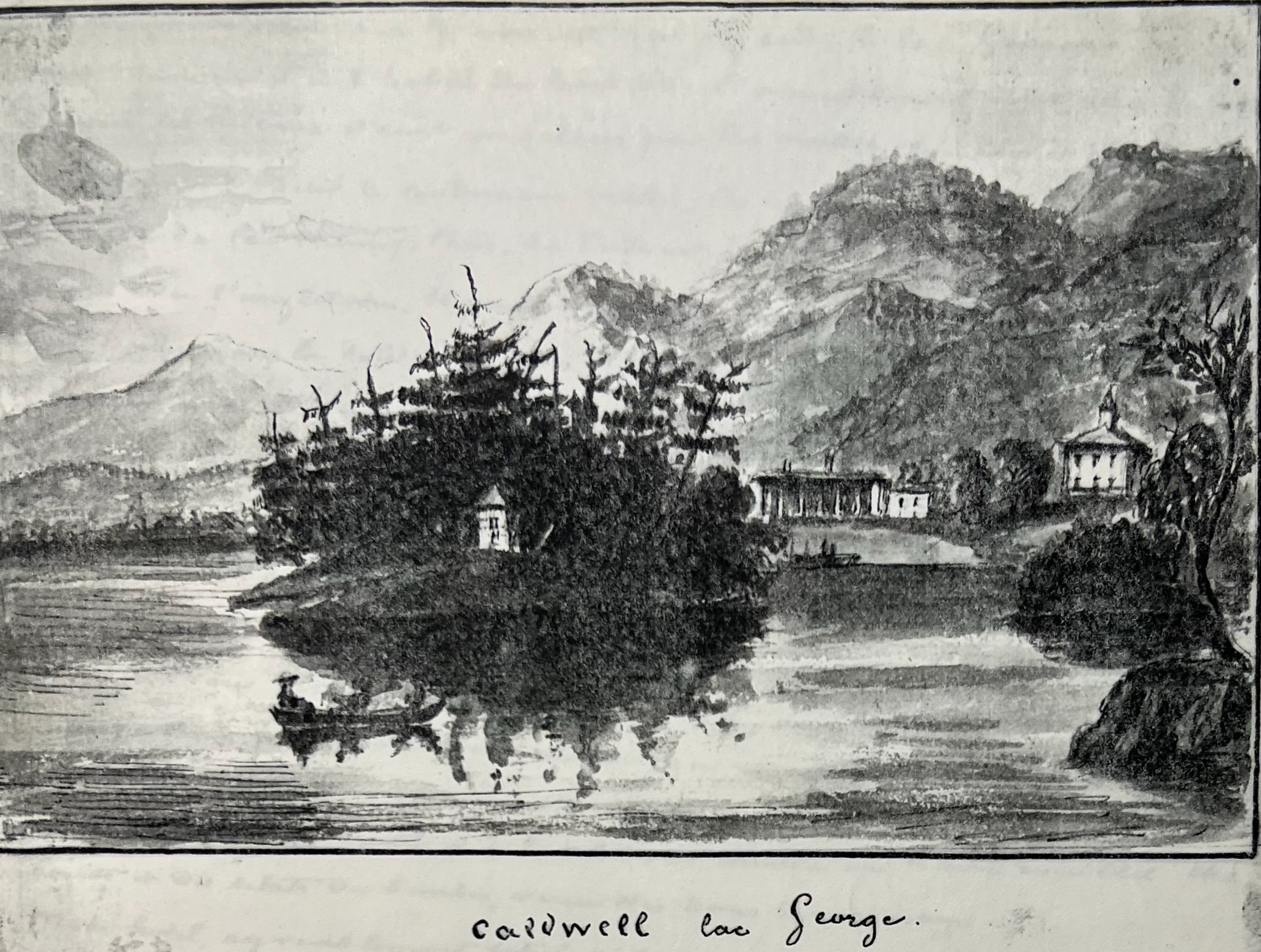
Lake George is much admired in the United States. Smaller than Lake Champlain, it was more graceful. We sailed constantly in sight of the lake's two shores, which lie very close to one another. Far off, at the head of a cove, we spied a great water-bird asleep among the rushes. At our approach it rose, beating its long white wings, uttering cries as if to reproach us for troubling its solitary meditations.
 (opens enlarged view)
I had conceived a fine passion for these mountains. I saw myself camping in the open air, hunting in the forests, fishing in the lake. What cooled my enthusiasm was a small animal a sailor showed us at the bottom of a glass cage. It was a rattlesnake he had caught in the neighborhood.
At 4 h in the afternoon we reached the end of Lake George. The boat stopped close by a sanded walk that led us across a meadow to the portico of a hotel placed there like a spider's web to catch travelers as they pass.
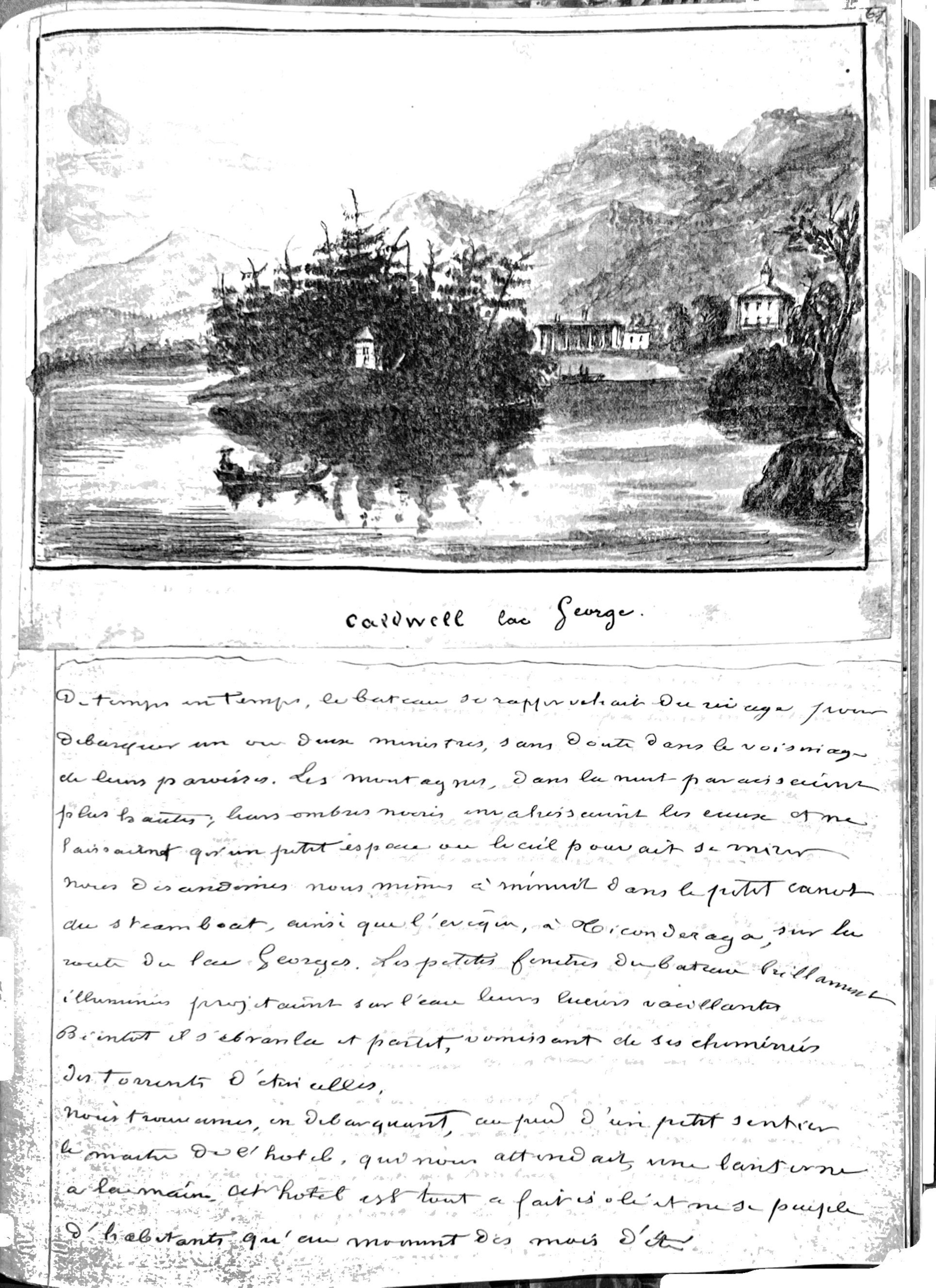
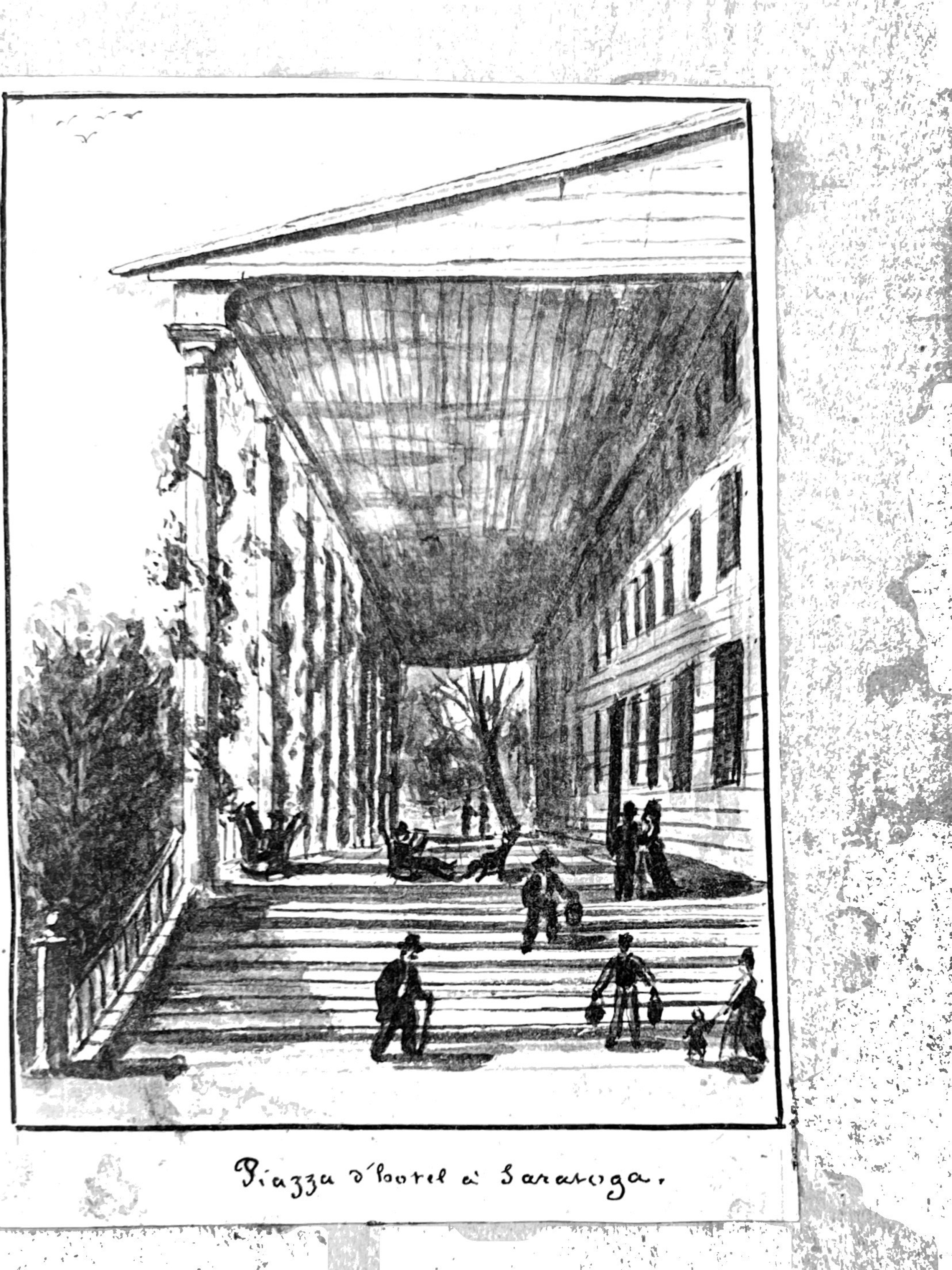
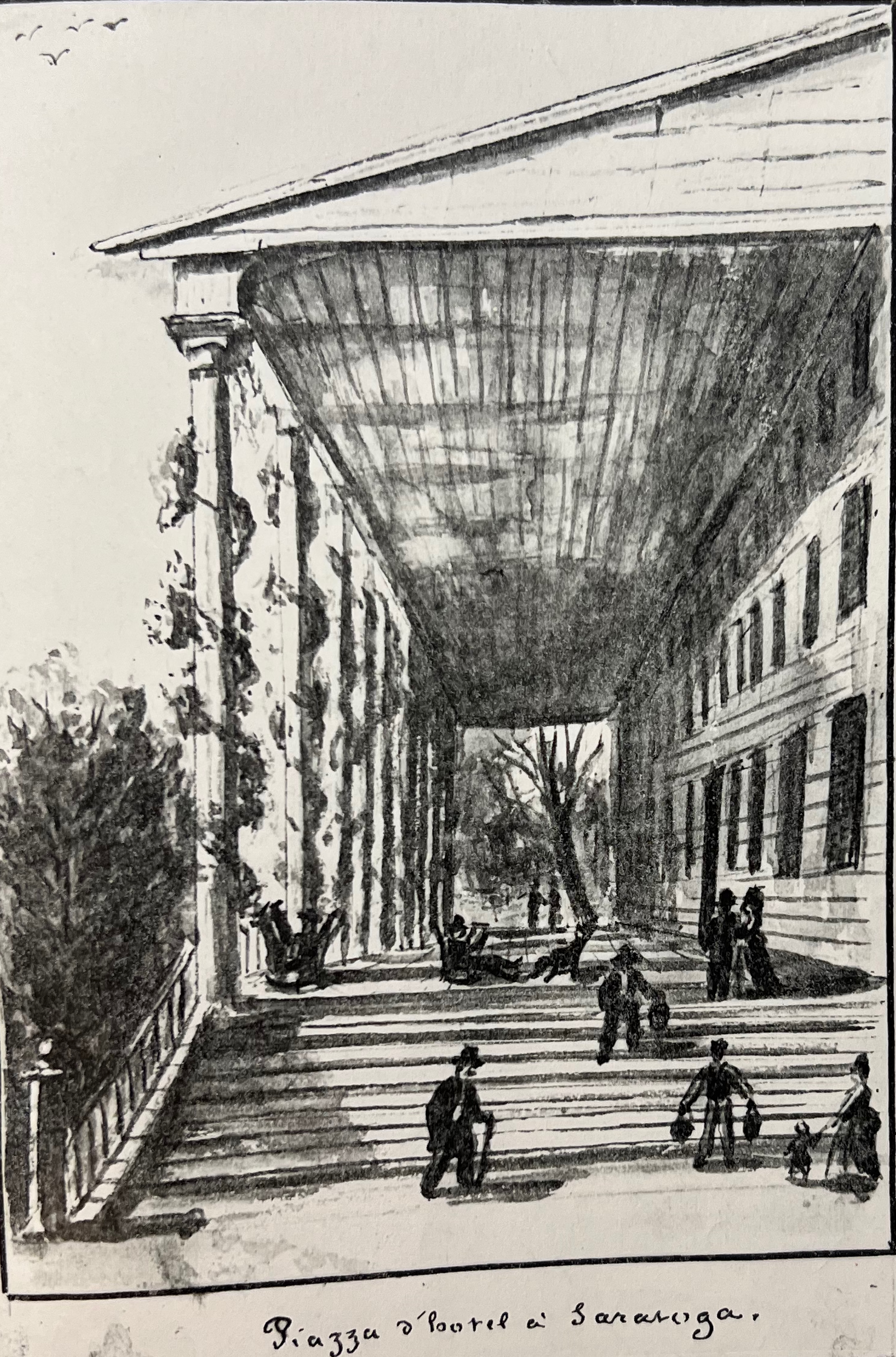
The hotel's position is charming. The houses of the village of Caldwell rise around it. Its great wooden portico had an oriental look. Americans seated all around us appeared indifferent to the beauty of the place. They talked briskly, cigar in mouth, of banks, of paper currency, of financial crisis &c
While we gave ourselves up to reverie under those porticoes borne on slender columns hung with lianas and climbing plants, an inspection of our pockets brought us back to sad reality. Our funds were sinking with such rapidity that we had to regain New York at the earliest, on pain of going bankrupt if we delayed longer. This bitter thought poisoned our stay at Caldwell,
We left the next morning for Saratoga in a stage where we had for traveling companions Bishop Onderdonck and an American surrounded by business.
The road offers nothing remarkable but its ruts and its jolts. We came to a point where it crossed a marsh on a kind of bridge of tree trunks laid side by side. One section had given way and sunk into the mire. A gaping hole stopped us; we got out of the carriage. The driver was not troubled by so small a matter. He tore up a few pieces of timber from the sides of the causeway then, climbing back onto his seat, lifted his team away with cracks of the whip. The four horses sprang into a gallop. The empty carriage gave one bound, and the whole affair found itself transported onto solid ground.
This maneuver had charmed our companions, who complimented the driver — a true Yankee, who was daunted by nothing.
Stopping in a small village to change horses, we saw an entrepreneur with his daguerreotype machine surrounded by a curious crowd.
Farther on we passed through the village of Glens Fall. It has nothing remarkable but waterfalls, which industry has seized upon like treasure-trove. The falls, masked by mechanical sawmills and a covered bridge, were scarcely visible.
I lent an ear to the conversation of our two neighbors. Bishop Onderdonck was discussing with the merchant the Catholic dogma of transubstantiation. The faithful man complained of understanding nothing of it. The bishop, instead of calling it a mystery, admitted that this dogma was muddled. He admitted nevertheless that the Catholics were not so much to blame, since the dogma was current in the church before Protestantism.
This bishop had papist leanings so pronounced that some time later his flock — unable to depose him — placed him on the retired list under the pretext that he was too amiable with the ladies; a thing that made me laugh. He was a fat old fellow in gold spectacles who in no way resembled a Don Juan.
Here we are at Saratoga, town of mineral waters, where in the hot season the people of the south repair, and generally all the elegant society that feels the need to amuse itself and to spend its dollars gaily.
It was a desert when we passed through. The season had not opened. On every side one saw great hotels shut up, boarding houses, bowling greens, stables of horses and carriages at rest.
In spite of the sunshine the weather was cold. Our only resource for reaching New York the next day — given the penury of our funds — was to reach Albany that evening and board the night steamboat. The next day was a Sunday; failing that, we were threatened with staying thirty hours in Albany and remaining there stranded, without money.
We asked a carriage-hirer what he would take to drive us straight to Albany. He asked us $40 — 200 francs — the price on which we had traveled for a week.
We had to wait for the railway, which set us down at Schenectady, where we climbed into a stage in the company of three charming young American ladies. My companion wanted to address them. I stopped him; it was contrary to the customs of the country; we needed an introducer, and we had none. They were coquettish, burst out laughing, threw us mischievous glances.
At last the carriage enters the streets of Albany. We pass our own hotel without telling the driver to stop there. We wanted to escort our nice neighbors to their door. The carriage climbed the slopes that led to the top of the town, one of these young ladies, using her hand as a speaking-trumpet, called to the driver: to the right, to the left, farther on, Stop! We left them on the steps of a house of modest appearance. The father, who had come out onto the porch, cigar in mouth, touched their hands and asked after their health, remaining impassive. The three scatterbrains burst like a bombshell into the house.
The driver, when we told him to take us to the Eagle hôtel, observed ill-humoredly that we might well have stopped there when we passed its doors. We feigned an astonishment mingled with innocence
The New York boat had left. We no longer had the means to pay for our stay at the hotel. Let us dissemble, let us dine, let us sleep, the night brings counsel.
The next morning at breakfast time, we approached the counter, hoping to interest our host — thanks to our youth — by the tale of our position. We offered him our baggage as security, or to wait for a remittance from New York. Our speech was ill received In any case, one had to breakfast. Entering the dining room Judge of our unhoped-for happiness! A Frenchman, a Lyonnais of our acquaintance, was there at table before a beefsteak washed down with tea! He was on his way to Boston. All difficulties ceased; he lent us the little we needed. We took one last carriage drive with him. Blessed be Édouard!
The next morning we went aboard the boat, and that evening we re-entered the furnace of New York.
 (opens enlarged view)
— Fin —